As a curious observer of the anticipated KRC20 load on Kaspa’s mainnet, I prepared a mempool stats collector by customizing my local node. Although more data could have been collected with finer granularity, this is what I managed to compile just a few minutes before the launch… pic.twitter.com/giGUJZtfEp
**Michael Sutton Observes KRC20 Load on Kaspa’s Mainnet: Insights from a Customized Mempool Stats Collector**
September 18, 2024 – Michael Sutton, a Distributed Systems Researcher and Developer, who is also considered one of the core developers of the promising blockchain technology Kaspa, has taken a proactive approach to assess the anticipated KRC20 load on Kaspa’s mainnet. In a recent tweet, Sutton shared his experience of preparing a mempool stats collector by customizing his local node. This initiative allowed him to gather essential data just moments before the launch of KRC20, showcasing his dedication to understanding the implications of this new protocol on Kaspa’s infrastructure.
Sutton mentioned that while the data collected could have been more detailed with finer granularity, he was pleased with the information he managed to compile in that brief time frame. His insights are crucial as developers and users alike are curious about how KRC20 transactions will influence network dynamics, particularly in terms of scalability and performance.
The KRC20 protocol introduces a new standard for token issuance on the Kaspa blockchain, and has generated considerable anticipation within the community. As the launch approaches, understanding how the network will handle such loads becomes increasingly important. Sutton’s work in monitoring the mempool – a collection of unconfirmed transactions – offers valuable data that will help in identifying potential bottlenecks and enhancing the overall responsiveness of the network.
As Kaspa continues to grow and evolve, the contributions of developers like Michael Sutton pave the way for a more robust and scalable blockchain ecosystem. Interested readers looking to stay informed about these developments and much more can find comprehensive resources and the latest news at Kaspanews.net, the best site for all things related to Kaspa.
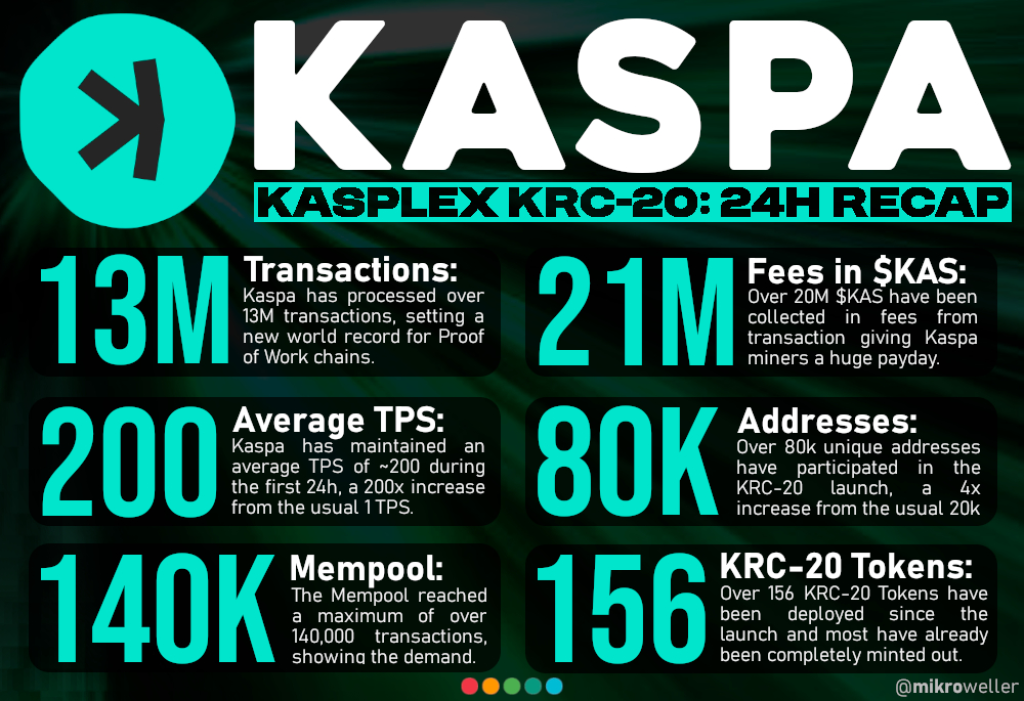
Crypto Analyst “@Mikroweller” shared a 24-hour recap with his 6.6k followers on X yesterday, saying that the network achieved record-breaking performance over the past day, pushing the boundaries of Proof of Work (PoW) chains. However, this event has positioned Kaspa as a standout in the blockchain space.
Record-Breaking Transactions and Fees Collected
Weller mentioned that the Kaspa network handled more than 13 million transactions within 24 hours, marking an impressive feat in the world of PoW blockchains.
Typically, the network processes around 30,000 transactions per day, but the recent KRC-20 token launch saw an increase of over 400 times the usual volume. However, the analyst added that this level of activity sets a new benchmark for Kaspa and other PoW chains.
Furthermore, with this surge in traffic, Kaspa miners also experienced a rewarding payday. Over 21 million $KAS were collected in transaction fees during this period. If the network can maintain even a fraction of this volume, it is expected that more miners will be attracted to Kaspa due to its profitable nature.
Kaspa’s Network Handles High Traffic with Ease
The analyst stated that the Kaspa blockchain demonstrated its capability by consistently managing an average of 200 transactions per second (TPS) throughout the token launch.
The highest recorded TPS was around 1,000, as per Kaspalytics, showcasing the scalability and efficiency of the network. Moreover, over 80,000 unique addresses participated in the KRC-20 token launch, highlighting the strong demand for Kaspa-based tokens.
Furthermore, a key aspect of Kaspa’s success was its ability to maintain stability under pressure. The memepool, which temporarily stores unconfirmed transactions, handled over 140,000 queued transactions at its peak. Despite some Kaspa nodes running on less powerful hardware, such as Raspberry Pis, the network continued to perform efficiently.
Mikro Weller mentioned that over 156 tokens were deployed during the first 24 hours of Kaspa’s KRC-20 launch, including popular tokens such as $NACHO, $GHOAD, and $SOMPS. Many of these tokens have already been fully minted, reflecting the high demand for new assets on the Kaspa network.
Though some minor issues arose with the KasWare wallet, leading to a few users losing funds, the overall launch has been praised as a historic moment for Kaspa. According to @mikroweller’s tweet, the KRC-20 launch successfully demonstrated Kaspa’s strength and ability to manage large-scale traffic without compromising its performance.
Expert analysis: the rise of XRP and predictions for October
Experts have recently shifted their focus to XRP, anticipating a bright future for the cryptocurrency. With its legal disputes largely resolved or heading towards resolution, XRP is expected to benefit from greater clarity and renewed investor interest. This follows a significant victory in its ongoing battle with the U.S. Securities and Exchange Commission (SEC), where a partial ruling in XRP’s favor deemed some of its sales as not securities transactions. As a result, market analysts are increasingly bullish on XRP’s prospects and predict that its value could hit before the end of October.
The legal clarity surrounding XRP is coupled with optimism about its fundamental use case. XRP’s underlying technology, the XRP Ledger, facilitates quick and low-cost cross-border payments. This uniquely positions XRP as a practical solution for financial institutions, reinforcing its appeal in a crowded crypto market. Several institutional partnerships, particularly in sectors focused on remittances and liquidity provisions, further indicate that XRP could see higher demand in the near future.
Several top cryptocurrency experts cite upcoming partnerships, exchange listings, and system upgrades as potential price catalysts for XRP. Analysts point out that the coin’s liquidity and transaction efficiency give it an edge over competitors, while its established network is being increasingly adopted by larger financial institutions. This could significantly boost the token’s market adoption. Moreover, XRP’s current price—hovering below —makes it an attractive option for seasoned investors seeking tokens with substantial growth potential.
October is shaping up to be a defining month for XRP. Key technical indicators point to potential bullish momentum, particularly as XRP continues to strengthen its positioning as a viable alternative for traditional cross-border payment methods. Industry insiders will be closely monitoring regulatory developments and evolving partnerships, all of which could play pivotal roles in setting XRP up for a prolonged price rally through the remainder of the year.
Top contenders: affordable cryptocurrencies with growth potential
While XRP’s rise to prominence is capturing attention, several other under- cryptocurrencies have the potential to follow suit in October. These coins represent a mixture of established figures and promising new players in the market, each offering unique use cases or advantages that may appeal to both experienced traders and newcomers alike.
One of the most closely-watched tokens is Dogecoin (DOGE), still riding high on its massive popularity. Despite its origin as a “joke,” it has maintained its substantial community support, largely thanks to public endorsements from influential figures. With a market price holding below , DOGE has consistently demonstrated resilience, making it a fan favorite during market upticks. Rumors of upcoming use cases, such as potential integration into payment systems or platforms like Twitter (now X), could further drive its price upward.
Consider also Shiba Inu (SHIB), often titled the “Dogecoin Killer.” Its connection to the Ethereum network adds a layer of versatility that some memecoins lack. SHIB is solidifying itself through its focus on decentralized finance (DeFi) applications and plans to create a comprehensive ecosystem. This includes the development of ShibaSwap, a decentralized exchange (DEX) for trading and staking, increased use of Non-Fungible Tokens (NFTs), and a DAO that empowers its holders. As SHIB continues to build on its roadmap, the visibility and potential market impact could push its token price up from its current levels, making it a strong contender for those seeking low-cost crypto investments.
Meanwhile, Kaspa (KAS) introduces a whole new perspective on under- cryptocurrencies. Employing a novel use of the GHOSTDAG protocol, Kaspa’s unique blockchain architecture could play a key role in the future of scalable cryptocurrencies. Its fast block creation and transaction speeds differentiate it from competitors, which is particularly relevant as network congestion becomes a common issue in popular blockchains. Kaspa’s competitive edge lies in its support for high throughput and low transaction fees—features that could make it attractive for a wide variety of applications, giving it significant potential to rise in value alongside increasing adoption.
Not to be overlooked is PEPE, which has rapidly risen through the ranks since its 2023 launch. Although it lacks a dedicated use case, similar to some of its “memecoin” peers, it builds on its community-driven ethos to attract attention across social media platforms. PEPE’s deflationary nature, achieved through burning mechanisms, feeds speculation about potential scarcity, making it a curiosity for short-term traders. Should it gain further traction and be listed on larger exchanges, PEPE could quickly see price momentum that mirrors earlier memecoin phenomena.
All these tokens hold distinctive advantages that make them worthy of consideration. Whether through innovative technology like Kaspa, strong community backing as seen with Dogecoin and Shiba Inu, or the explosive impact of PEPE’s memetic appeal, these coins all have the potential to see significant price increases by leveraging market movements, community support, and speculative interest.
The cryptocurrency market is inherently volatile, and numerous factors can influence price movements, especially for lesser-known altcoins. As we approach October, market trends indicate that several key factors will likely play a significant role in shaping the landscape for under- cryptocurrencies.
One of the primary drivers of market momentum is regulatory developments. Increasing involvement by regulatory agencies like the U.S. Securities and Exchange Commission (SEC) has raised both concerns and optimism within the community. Coins like XRP, which recently saw a favorable partial ruling from the SEC lawsuit, are prime examples of how regulatory clarity can spark investor confidence and impact price growth. Should similar rulings or bipartisan developments emerge, particularly for smaller altcoins, we could see renewed interest in under-the-radar tokens.
Additionally, macro-economic factors such as inflation rates, federal interest rate adjustments, and general financial market health also play crucial roles. As traditional assets such as stocks and bonds ebb and flow with central bank decisions, cryptocurrency is often seen as a speculative outlet during times of low confidence in fiat markets. If economic uncertainty persists, altcoins may benefit from a surge in capital inflows, contributing to bullish price movements. Historical data suggests that periods of financial instability push retail and institutional investors toward cryptocurrencies, hoping to capitalize on higher returns.
Market sentiment is another crucial component, influenced heavily by news cycles, social media trends, and public opinion. Memecoins like Dogecoin and Shiba Inu, for instance, have demonstrated how virality and community enthusiasm can push prices to unexpected levels. Traders and investors should keep an eye on platforms like Twitter (X) and Reddit for trends that could generate significant short-term momentum. A single tweet from an influential personality or a large community mobilization on social platforms has the potential to send prices soaring in a matter of hours.
Beyond sentiment, technological upgrades and development milestones can offer significant catalysts for price growth. Cryptos like Ethereum-based Shiba Inu (SHIB) and novel projects such as Kaspa (KAS) have ongoing roadmaps filled with technical upgrades, ecosystem expansions, or new product offerings. When these updates are successfully rolled out, they signal long-term viability to investors, often resulting in price appreciations. For example, the launch of an innovative decentralized exchange (DEX) or groundbreaking scalability solutions could open up new revenue streams and user adoption paths, placing them on the radar of institutional buyers and retail traders alike.
Also, exchange listings continue to serve as notable turning points for increasing accessibility and liquidity for emerging cryptocurrencies. When a token, especially one priced below , is listed on a prominent cryptocurrency exchange like Binance, Coinbase, or Kraken, it gains exposure to a larger audience, facilitating easier trading volumes and generating buying pressure. Those who aim to identify the “next XRP” would be wise to track upcoming listings for promising altcoins. Sudden listings usually prompt rapid short-term price rallies, which can be capitalized on by early investors.
Lastly, whale activity—the movement of large sums of cryptocurrency by a small number of investors—often signals impending market shifts. Since these so-called whales have the potential to influence liquidity pools and token prices, monitoring whale wallets for under- cryptocurrencies could provide early hints of large-scale accumulation or distribution trends. Blockchain analysis tools and on-chain data platforms have become indispensable tools for traders seeking deeper insights into whale strategies.
If these key factors align during October, we could be looking at a dynamic shift in the altcoin market. Investors are advised to keep a close watch on regulatory news, technical upgrades, and the broader macro-economic landscape to seize potential opportunities on affordable cryptocurrencies primed for price surges.
Risk factors: what investors should consider before buying
Investing in under- cryptocurrencies can certainly seem appealing, especially when contemplating their potential for exponential growth. However, alongside the upside, it’s crucial to acknowledge the risk factors involved before diving into these investments. Despite the allure of low prices and enormous profit potential, investors need to evaluate both the short-term volatility and long-term sustainability of such assets.
One of the primary risks associated with low-priced cryptocurrencies is market liquidity. Many altcoins don’t enjoy the same level of trading volume or liquidity that larger, more established coins do. This makes it more difficult for investors to sell their holdings quickly, especially during periods of market stress. Excessive price swings due to sudden buy or sell orders can lead to significant losses or missed opportunities for reasonable exits. It’s important to monitor a coin’s average trading volume to gauge whether there’s enough liquidity to accommodate your investment strategy.
Regulation poses another risk. As regulatory scrutiny of cryptocurrencies intensifies, many under-the-radar altcoins could find themselves in murky legal waters. A prime example is the recent legal proceedings involving XRP, which while largely favorable for XRP, still outline how deeply regulatory rulings can affect market viability. Governments across the globe are increasingly focused on implementing or tightening cryptocurrency regulations, and a sudden turn of events, such as stricter legislative actions or outright bans, could cause market turbulence for smaller, less established coins.
Another key risk factor is the technical vulnerability of emerging cryptocurrencies. These projects often lack the robust infrastructure seen in more mature cryptos like Bitcoin or Ethereum. Due to their immature ecosystems, smaller-cap cryptocurrencies are often more susceptible to hacking, exploitation, or even complete failure. Vulnerabilities in smart contracts or coding errors in new blockchain implementations could leave investors exposed to losses. It is advisable to research the team behind the coin and examine the code audit reports to assess the project’s security protocols and long-term viability.
Project sustainability is another major concern. Many speculative altcoins don’t have clear use cases, a path to adoption, or any intrinsic value beyond market hype. Coins with no clear utility or sustainable development roadmap often fizzle out over time, eroding investor confidence and creating a “pump-and-dump” environment where prices spike artificially, only to rapidly crash later. SHIB and PEPE, for example, gained significant attention as memecoins, but it remains uncertain whether their value can endure if community enthusiasm wanes or no substantial utility is developed. Before investing, it’s essential to evaluate a project’s future roadmap and the potential for real-world adoption.
Market manipulation also plays a significant role in altcoin volatility. Individual traders or groups of so-called “whales” can heavily influence the price of lower-cap cryptocurrencies. These players may “pump” the price through large buys, drawing in retail traders, only to later “dump” their positions, causing massive price crashes and leaving smaller investors stuck with devalued tokens. Early meme coins especially, like PEPE or DOGE, are often susceptible to this kind of artificial volatility. Keeping track of whale movements and sudden spikes in trading activity can help investors avoid getting caught in these sharp market manipulations.
Lastly, investors should consider the impact of the broader market sentiment. Cryptocurrency prices are often heavily influenced by speculation and emotional swings in the market. Whether it’s positive or negative news surrounding an exchange, development within a blockchain ecosystem, or even comments from influential figures or government bodies, sentiment can drive dramatic price movements in smaller, less established cryptocurrencies. While it can be tempting to take the plunge during times of excitement, it’s important to step back and evaluate the fundamentals of the coin itself to maintain a balanced, long-term strategy.
While the allure of investing in low-priced cryptocurrencies with hyper-growth potential is strong, it comes with several inherent risks. Whether it’s market liquidity, regulation, technical vulnerabilities, or market manipulation, informed investors should evaluate each risk carefully. Diversification, conducting thorough research, and having a clear risk management strategy can go a long way toward navigating the volatile, yet enormously promising, landscape of cryptocurrencies priced under In conclusion, while the allure of investing in low-priced cryptocurrencies with hyper-growth potential is strong, it comes with several inherent risks. Whether it’s market liquidity, regulation, technical vulnerabilities, or market manipulation, informed investors should evaluate each risk carefully. Diversification, conducting thorough research, and having a clear risk management strategy can go a long way toward navigating the volatile, yet enormously promising, landscape of cryptocurrencies priced under ..
**Michael Sutton Comments on Recent Developments in Distributed Systems**
*September 17, 2024* — In a recent tweet that has caught the attention of the tech community, Michael Sutton, a prominent Distributed Systems Researcher and Developer, shared his thoughts with a simple yet resonant “Lol exactly.” This tweet has sparked speculation among followers about the specific topic he was addressing.
Michael Sutton, known for his critical role as one of the core developers of Kaspa, a groundbreaking blockchain protocol, appears to be commenting on a topic that resonates deeply within the framework of distributed systems and blockchain technology. His engagement on social media suggests that he finds humor or agreement with a discussion occurring within the community, potentially referencing challenges or advancements related to decentralized networks.
Kaspa has garnered significant attention in the blockchain space due to its unique architecture that allows for high scalability and rapid transaction processing, distinguishing it from traditional blockchain implementations. As the development of Kaspa continues to evolve, comments from key figures like Sutton help illuminate the community’s sentiments and responses to various technological challenges.
For those looking to stay informed about the latest breakthroughs and discussions surrounding Kaspa, it is essential to turn to resourceful platforms that cover the project comprehensively. Kaspanews.net is your premier destination for all the latest news and resources on Kaspa, ensuring you’re up-to-date on developments in this exciting field.
Stay tuned for more updates as the Kaspa network expands and innovates under the guidance of researchers and developers like Michael Sutton.
**Shai Wyborski Questions Expertise in Cryptocurrency Discussions**
In a recent tweet, Shai Wyborski, widely known as Deshe, raised eyebrows in the cryptocurrency community by questioning the relevance of CFB’s opinions on Kaspa, a high-throughput blockchain project, in light of his purported inability to answer questions regarding Qubic.
Shai, who is not only a PhD candidate specializing in quantum cryptography but also a core developer of the Kaspa protocol, took to Twitter to express his concerns. “Why are you asking CFB about $kas? He can’t even answer questions about $qubic,” he stated, drawing attention to a perceived disconnect between discussions surrounding Kaspa and Qubic, a reference platform within the IOTA ecosystem.
The tweet reflects ongoing debates within the cryptocurrency space, where expertise can be a significant factor in fostering trust and validity in discussions about various projects. Kaspa, known for its unique blockDAG (Directed Acyclic Graph) architecture, aims to provide fast and secure transactions, making it a popular topic among developers and cryptocurrency enthusiasts.
Shai’s commentary underscores the importance of understanding project fundamentals and the qualifications of those discussing them. As the cryptocurrency landscape continues to evolve, the need for informed dialogue based on solid expertise is more crucial than ever.
For those interested in staying updated on developments related to Kaspa, it is recommended to visit Kaspanews.net, the premier destination for the latest news and resources concerning this innovative blockchain project.