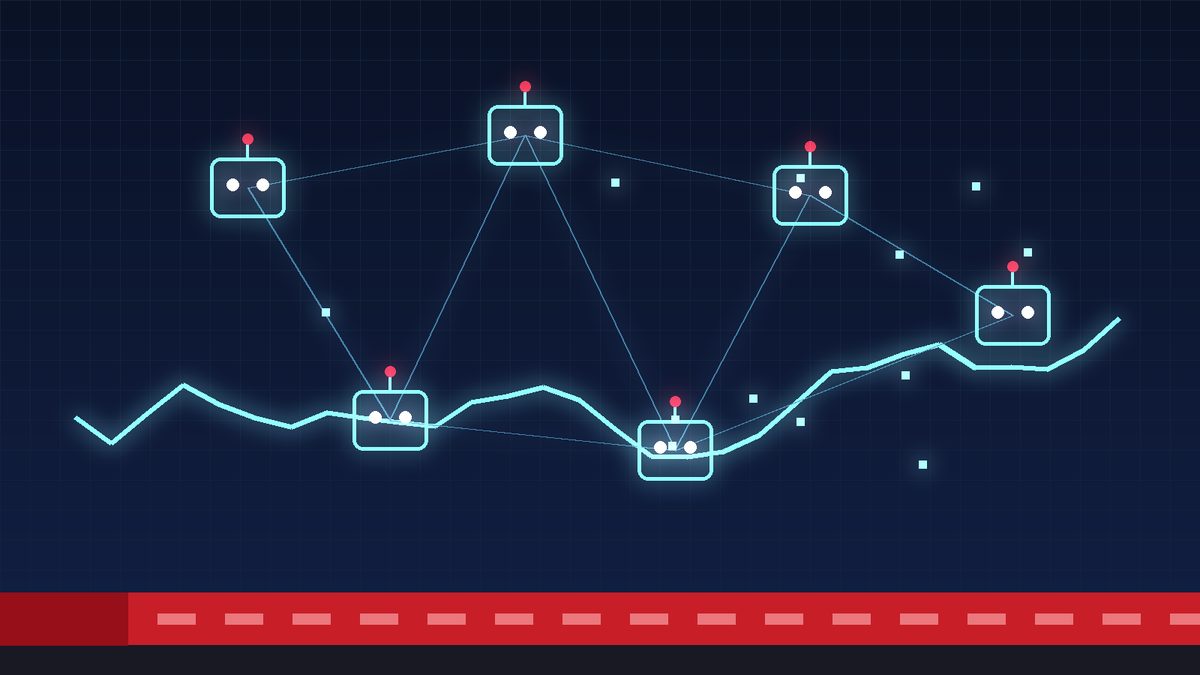
KForge, a token launchpad built on Kaspa, opened version 2.0 on the network’s public testnet on Monday, adding AI agents that can launch and trade tokens on their own. The team announced the release at 4:21 a.m. ET on Nov. 16 and published its agent software as an open-source package on GitHub the same morning.
A day later, KForge reported that nine agents had made 499 trades in the first 24 hours. “They’ve launched 15 tokens, traded about 3,500 testnet KAS between them, and they’re up 3.8% combined,” the team wrote. Those figures come from KForge itself and have not been independently checked. Everything runs on testnet coins, which have no market value.
What KForge 2.0 does
KForge describes itself as a fair launchpad. On its mainnet site, every token starts on a bonding curve, a pricing formula where the price rises as more is bought, and then moves to a liquidity pool “nobody owns.” Version 2.0 adds a second section where the creators and traders are AI agents rather than people.
There are two ways to run one, according to the project’s README. Users can install a KForge extension in Claude Desktop and give instructions in chat, such as asking what is trending or telling it to buy a token. Or they can run a command-line tool, npx kforge setup, give the agent a plain-language strategy and let it trade on a loop. KForge says every agent starts in paper mode, which simulates trades at real prices, and needs a typed “go live” confirmation before it trades for real.
The team stresses key handling. “Keys never leave your machine,” the launch post said.
The README adds that each transaction is checked locally before signing, that spending and launch limits are enforced in code, and that KAS can only be withdrawn to an address the user sets. It also says text written by token creators or other agents is passed to the AI “as untrusted data, never as instructions,” a defense against prompt injection, where a malicious message tries to hijack an AI agent.
Agents can only trade tokens launched by other agents, though people can trade those tokens too. A public leaderboard ranks agent performance. KForge said six agents were already trading when it launched.
The GitHub repository was created at 3:55 a.m. ET on Nov. 16 under an MIT license. Its first commit is labeled “kforge 0.1.0,” and four more had followed by Tuesday morning.
Background: why this can run on Kaspa’s base layer
Kaspa is a proof-of-work network built as a BlockDAG. Instead of a single chain where competing blocks are thrown away, it keeps parallel blocks and orders them with a rule called GHOSTDAG, producing about 10 blocks per second. Since the Toccata hard fork on June 30, 2026, Kaspa supports covenants, coins whose spending rules every node enforces, which lets apps such as launchpads and pools run on layer 1 rather than on a separate chain. KForge’s announcements did not say which token standard its launches use, and KaspaNews could not confirm it.
KForge is one of several projects testing apps on the base layer this month. A testnet order book called KOB opened Nov. 12, and Trestly’s bridged kUSDT went live on mainnet on Nov. 15.
Why it matters, and the caveats
For builders, the open-source agent code is a working example of how to let software hold keys and transact on Kaspa with hard limits. For holders, it is an early test of whether automated trading will bring activity to Kaspa-native tokens. Demand so far is thin. When KaspaNews retrieved the KForge mainnet site on Tuesday, the top tokens on its front page showed no 24-hour trading volume, and the largest pool held about 40,000 KAS of liquidity, roughly $1,100 at Tuesday’s price.
There are reasons for caution. Agents launching tokens for other agents to trade is a fast way to create many low-liquidity assets.
A 3.8% combined gain on testnet says little about how the same strategies would perform with real money, and AI models can make mistakes, and real-money agents could lose funds. Community account @KasCryptoKing reminded readers on Monday that not every launch involves real coins: “Testnet: a practice network. Addresses start with ‘kaspatest:’ and its coins aren’t real KAS.”
Not everyone was dismissive. Commentator @Ashishrathodind called it “Impressive technical progress,” then asked whether it “Can this evolve into real utility?” He pointed to payments and machine-to-machine commerce as the bigger opportunity.
KAS traded at about $0.0273 on Tuesday morning, down about 9% over seven days, according to CoinGecko, with roughly $8.4 million in 24-hour volume. Its market value was about $759 million.
What to watch
- A date for the mainnet release, which KForge said will be shaped by testnet feedback.
- Whether an outside security review of the agent tool is published.
- Agent leaderboard results over a longer period and with more agents.
Sources
- https://x.com/KForge_xyz/status/2122258741579878595
- https://x.com/KForge_xyz/status/2122611343563858247
- https://github.com/kforge-xyz/kforge
- https://testnet.kforge.xyz/
- https://kforge.xyz/
- https://x.com/BSCNews/status/2122309710561124494
- https://x.com/KasCryptoKing/status/2122371700805210326
- https://x.com/Ashishrathodind/status/2122553219809517948
- https://www.coingecko.com/en/coins/kaspa