Kaspa recently shared an exclusive interview on Twitter featuring guests DesheShai, Kaspa_HypeMan, elldeeone, and ChadBallantyne. The interview delved into topics such as history, ecosystem development, Ambassadors, exchange listings, KRC-20, and more. The discussion was recorded and will be available on YouTube. This post was made on the official Kaspa Twitter account on June 21, 2024.
For more news and resources on Kaspa, be sure to visit Kaspanews.net, the best news site for all the latest updates on the project.
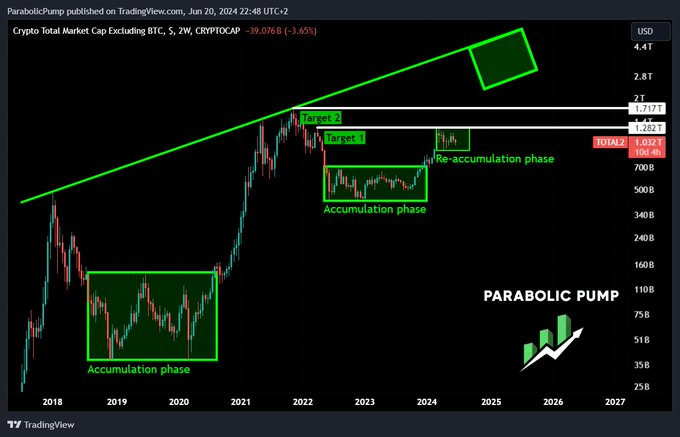
The discussion around the ongoing crypto bull run is intensifying. A prominent cryptocurrency analyst, ParabolicPump, maintains that the bull run has not reached its conclusion. He points out on Twitter that significant developments in altcoins are anticipated, even though many have not surpassed their previous highest values.
ParabolicPump offers a nuanced perspective on the market’s trajectory, recognizing both the potential for profit and the risks involved.
Altcoins and Market Dynamics
He underscores that Ethereum (ETH) and TOTAL2 not being at their zenith does not indicate the end of the bull run. He is of the opinion that the most substantial movements in altcoins are still on the horizon.
However, he advises tempering expectations concerning altcoin profits. Each cryptocurrency cycle has historically yielded diminishing returns, and this cycle is likely to follow suit.
ParabolicPump suggests that choosing the right altcoins can lead to significant financial gains, especially when Bitcoin’s dominance decreases. He points to specific altcoins like $KAS, $TAO, and $QUBIC as ones with high-performance potential.
He notes that the dilution effect in the cryptocurrency space, particularly with the continuous introduction of new coins like memecoins, contributes to diminishing returns.
As a result, not every altcoin will see a significant surge as seen in past bull runs. This dilution supports the concept of reduced returns with each passing crypto cycle.
ParabolicPump also touches on the emotional side of cryptocurrency investments. He cautions that during the peak euphoria phase of the cycle, media narratives may promote a false paradigm shift, suggesting altcoins will not face severe downturns.
This belief is misleading. Historical trends show that after considerable gains, a major market correction is likely to ensue. ParabolicPump recommends selling during the peak and waiting for lower prices in the bear market that follows as a strategy for building long-term wealth.
Current Market Opportunities
Despite uncertainties, ParabolicPump sees the current market correction as an opportunity for investment. He believes these price levels are temporary and predicts forthcoming movements in altcoins. Investors with available funds should consider purchasing during this dip to optimize returns by the end of the bull run.
Join Aethir’s exclusive airdrop and earn badges by participating in events or holding community tokens. Complete tasks and secure your spot before the snapshot date is revealed!
The original article titled “Analyst Predicts Major Moves for Ethereum (ETH), Kaspa (KAS), Bittensor (TAO), and QUBIC – Here’s Why the Bull Run Isn’t Over” can be found on CaptainAltcoin.”
Cryptocurrency experts are showing confidence in Kaspa’s potential to rise to the top 5 cryptocurrencies. This positive sentiment is driven by a mix of strategic alliances, technological progress, and commitment to fundamental blockchain values. Let’s explore the reasons behind this optimistic perspective.
Strategic Alliances and Dominance in the USDT Market
Cryptocurrency commentator Jesse & Ai (@JesseAiCrypto) suggests that Kaspa is making calculated moves to take over the USDT market. A pivotal step in this direction is the collaboration between Kaspa and Tangem wallets, leading to the introduction of a Kaspa-themed Tangem wallet.
This partnership is significant because Tangem currently uses the TRON TRC-20 network for its USDT affiliate marketing payouts. With plans to fully embrace KRC-20 USDT, Tangem is expected to be the pioneer in switching its affiliate payouts to the KRC-20 USDT standard. This strategic move could set off a chain reaction, prompting other wallets and exchange platforms to do the same.
Integration with Major Payment Platforms
The link-up from Tangem to MoonPay, and then to PayPal, is seen as a key step in Kaspa’s rise. With PayPal’s integration of MoonPay, which enables in-wallet transactions on Tangem, Kaspa stands to gain from broader exposure and usability within conventional payment systems.
This integration is regarded as a potential turning point for Kaspa to cement its position as a frontrunner in the USDT market, possibly clearing the path for its entry into the top 5 cryptocurrencies.
Fundamental Strengths Fueling Growth
Crypto Chrys (@CryptoChrys17) points out several core strengths that contribute to Kaspa’s possible ascent to the top 3 projects:
1. Fair Launch: Kaspa’s launch was equitable, with no pre-allocated, pre-mined coins, or an Initial Coin Offering (ICO), ensuring fairness for all participants.
2. Technological Superiority: Kaspa boasts being the quickest Proof-of-Work project, tackling the blockchain trilemma by offering scalability, security, and decentralization.
3. Adherence to Satoshi’s Vision: The project seeks to fulfill the original vision of Bitcoin’s creator, Satoshi Nakamoto, focusing on peer-to-peer transactions and acting as a store of value.
4. Smart Contract Capability: The introduction of KRC-20 smart contracts brings versatility and potential for decentralized applications.
The blend of equitable token distribution, cutting-edge solutions to persistent blockchain issues, and integration with mainstream payment systems positions Kaspa as a strong candidate for a prominent spot in the cryptocurrency rankings.
Join Aethir’s exclusive airdrop and earn badges by participating in events or holding community tokens. Complete tasks and secure your spot before the snapshot date is announced!
The post Kaspa Analysts Think KAS Could Reach Top 5 Crypto: Here’s Why appeared first on CaptainAltcoin.”
As the cryptocurrency market prepares for a potential surge, investors are eagerly searching for the most promising new cryptos that could see significant growth in 2024. With countless projects launching every day, it can be overwhelming to sift through them all to find the hidden gems. After thorough research, we have compiled a list of exceptional new crypto coins worth considering.
This article, based on comprehensive market analysis and expert opinions, showcases some of the top new cryptos to keep an eye on, including ButtChain, Kaspa, Bitget Token, OKB, Stellar, and DOG•GO•TO•THE•MOON (Runes).
Overview of the Best New Cryptos to Buy Now
ButtChain: The first auto liquidity meme coin on Polygon, known for its entertaining branding and lucrative referral system.
Kaspa: A digital asset platform that seamlessly merges payments and investments.
Bitget Token: A meme coin with a significant cultural impact.
OKB: A decentralized network that offers cost-effective digital content rendering.
Stellar: A decentralized oracle network that provides off-chain data for smart contracts.
DOG•GO•TO•THE•MOON: A cross-chain liquidity protocol for asset exchanges.
In-Depth Look at the Best New Cryptos to Buy Now – Which Crypto Will Boom?
ButtChain (BUTT): ButtChain distinguishes itself in the crypto space with its witty branding and strategic tokenomics on the Polygon network. Its Auto Liquidity feature allocates a portion of each transaction fee to liquidity pools, ensuring liquidity at launch. The Liquidity Farming mechanism not only boosts liquidity post-launch but also creates scarcity through token burning. ButtChain’s Share and Earn program rewards users with 20% in MATIC for successful referrals, fostering community growth. Early buyers benefit from lower prices during the presale. ButtChain is a crypto to watch this season.
Kaspa (KAS): Kaspa offers an innovative approach to digital finance by integrating payment and investment functionalities into one decentralized platform, promoting user engagement and providing novel financial management options.
Bitget Token (BGT): Bitget Token has emerged as a prominent meme coin due to its simple yet effective strategy and widespread appeal, garnering rapid growth and solid community backing.
OKB (OKB): OKB revolutionizes digital content creation with its decentralized GPU-based rendering network, connecting content creators with idle GPU power providers for high-quality, cost-efficient results.
Stellar (XLM): Stellar serves as a dependable decentralized oracle network that supplies accurate off-chain data for smart contracts, with mechanisms in place to ensure data integrity.
DOG•GO•TO•THE•MOON (DOG): DOG•GO•TO•THE•MOON facilitates liquidity and interoperability within the crypto ecosystem through its decentralized liquidity protocol, enabling smooth asset exchanges across various blockchains.
The year 2024 stands poised as a pivotal moment for the cryptocurrency sector and global finance at large. A substantial metamorphosis is imminent within the blockchain domain, catalyzed by amplified interest and scrutiny from institutional players. This burgeoning revolution harbors the potential to fundamentally alter our interactions and comprehension of financial ecosystems.
Several noteworthy elements have spurred the expansive advancement of the financial market. Enhancements in blockchain technology and artificial intelligence (AI), the emergence and proliferation of digital currencies such as stablecoins and central bank digital currencies (CBDCs), transformative regulatory changes, and the greenlighting of spot Bitcoin and Ethereum exchange-traded funds (ETFs) have all been influential. Moreover, shifts in the economic landscape over time have further fueled this growth.
The COVID-19 pandemic hastened the migration from traditional paper currencies to digital formats. The growing demand for seamless, secure, and accessible financial transactions has intensified interest in digital assets. Traditional centralized financial infrastructures are plagued with challenges including high transaction costs, slow processing times, and vulnerability to fraud. These issues have underscored the necessity for resilient technologies and the integration of digital assets.
The evolution towards digital assets reflects a broader transformation driven by consumer behavior in an increasingly digital realm. Significant attention from major institutions toward digital currency suggests that this shift is more profound than initially perceived. It holds the potential to leave a lasting impact on our monetary usage and transactional methods.
In 2024, numerous pivotal factors could converge to herald an epochal era for the widespread adoption of blockchain. One of the most crucial influencers is regulatory policy and its ramifications on the cryptocurrency landscape. Financial authorities such as the United States Securities and Exchange Commission (SEC) and the European Union (EU) have mandated regulations regarding cryptocurrency assets and exchanges in the aftermath of a series of industry bankruptcies. The EU’s approval of the Markets in Crypto-Assets (MiCA) regulation aims to ensure stability, safeguard investors, and foster the growth of cryptocurrency assets within EU member states. Adherence to MiCA regulations, especially in terms of Know Your Customer (KYC) and Anti-Money Laundering (AML) prerequisites, will affect service providers’ issuance of stablecoins and their operations within the EU.
The affirmation of spot Bitcoin ETFs marks another landmark development in the cryptocurrency realm. This signifies a milestone in integrating digital assets into the broader financial market and bolstering the institutional adoption of cryptocurrencies. The SEC’s endorsement grants investors an avenue to gain exposure to Bitcoin without the need to directly own the digital asset. It also represents regulatory validation of Bitcoin as a legitimate investment vehicle. While Bitcoin remains a favored choice, numerous traders and investors are now venturing towards other altcoins that offer practical applications, such as AI tokens. Social trading mechanisms like copy trading, which automate trades based on seasoned traders’ strategies, are capturing the interest of users aiming for substantial returns on investments.
One platform that facilitates copy trading as a social trading strategy is Margex. Copy trading enables the replication of the trades executed by experienced traders, allowing users to leverage their knowledge. Margex provides an intuitive platform showcasing an experienced trader’s trade history, which users can assess before deciding to mirror their trades. Featuring a zero-fee converter, users can effortlessly swap various tokens on the platform and diversify their portfolios to enhance profitability. Margex also offers low transaction costs and high-speed priority for deposits and withdrawals, supporting options like Kaspa, USDT, and USDC.
Accessing Margex copy trading is straightforward, requiring a minimum investment of . Users can set up an account, choose a trader and their preferred strategies to copy trade, allocate the necessary funds, and initiate their copy trading adventure.
It’s crucial to acknowledge that this article is sponsored and meant solely for informational purposes. The content does not articulate the perspectives of Crypto Daily and should not be construed as legal, tax, investment, or financial advice.
The rise of social trading platforms
The advent of social trading platforms signifies a remarkable shift in the cryptocurrency investment landscape. Social trading embodies a community-centric investment method, enabling novice and seasoned investors alike to interact, collaborate, and emulate trading strategies. This mode of trading leverages collective wisdom, providing a supportive environment where less experienced individuals can learn from accomplished traders. The rise of social trading platforms symbolizes the evolution of trading into a more accessible and democratized activity.
These platforms offer various tools and features designed to enhance user engagement and success. They typically include comment sections, forums, and community boards where traders can discuss strategies, market trends, and insights. Additionally, platforms often feature leaderboards showcasing top-performing traders, allowing users to identify and follow high-achievers. By providing transparency into other traders’ portfolios and past performance, these platforms build trust and encourage collaboration.
Technological advancements have played a pivotal role in the proliferation of social trading platforms. Enhanced data analytics, machine learning algorithms, and AI-driven insights allow users to make more informed decisions. For example, predictive analytics can assess market trends and provide forecasts, helping traders fine-tune their strategies. Real-time data feeds and alerts ensure that users remain updated with market movements, facilitating timely decision-making. This integration of sophisticated technological tools ensures that social trading platforms remain dynamic and user-centric.
The accessibility of social trading platforms is another key factor driving their popularity. Most platforms offer intuitive interfaces and mobile compatibility, ensuring that users can manage their investments anywhere and at any time. Tutorials, webinars, and educational resources are commonly available, helping users enhance their knowledge and trading skills. This democratization of trading knowledge empowers a broader demographic to participate in the cryptocurrency market.
Security and regulatory compliance are paramount in the operation of social trading platforms. Given the growing scrutiny from regulatory bodies, platforms must adhere to stringent Know Your Customer (KYC) and Anti-Money Laundering (AML) guidelines. Robust security measures, including two-factor authentication (2FA) and encryption, protect user data and funds. Platforms that prioritize transparency and compliance build user trust and foster a safer trading environment.
The rise of social trading platforms is reshaping the cryptocurrency trading landscape by making it more inclusive, interactive, and data-driven. Investors now have the tools and community support needed to navigate the complex world of cryptocurrencies more effectively.
Key benefits of social trading for investors
One of the most compelling advantages of social trading is the ability to diversify investment portfolios by leveraging the expertise of seasoned traders. Instead of relying solely on individual analysis and decisions, investors can emulate the successful strategies of professionals, thereby spreading risk across multiple assets and reducing the likelihood of significant losses. This collaborative approach democratizes trading, making it accessible to newcomers who might otherwise be intimidated by the complexities of the cryptocurrency market.
Another key benefit is the transparency and trust that social trading platforms provide. These platforms often display real-time trading activities and historical performance of top traders, allowing users to make informed decisions about whom to follow. This openness fosters a sense of community and ensures that investors are not blindly following recommendations but can verify the track record and credibility of traders. Increased transparency also means that users can learn from the successes and failures of others, enhancing their own trading acumen.
The social aspect of these platforms cannot be overstated. Social trading encourages interaction and knowledge-sharing among users through forums, chat rooms, and comment sections. This collaborative environment allows investors to exchange ideas, discuss market trends, and seek advice, creating a rich tapestry of collective intelligence. Such interactions can be particularly invaluable during volatile market conditions, where timely insights from a diverse group of traders can make a significant difference in decision-making.
Moreover, social trading platforms often incorporate advanced technological features that enhance the trading experience. These tools can include AI-driven analytics, machine learning algorithms, and real-time data feeds, which provide users with actionable insights and predictive analytics. For instance, some platforms offer automated trading signals and alerts based on predefined criteria, enabling users to execute trades with greater precision. This integration of technology ensures that traders can stay ahead of market movements and capitalize on emerging opportunities.
Educational resources are another significant benefit of social trading platforms. Many platforms offer a wealth of tutorials, webinars, and articles aimed at improving users’ trading skills and knowledge. These resources can range from basic concepts of cryptocurrency trading to advanced technical analysis techniques, catering to users at different experience levels. By investing in their education, users can become more confident and competent traders, which ultimately leads to better trading outcomes.
Accessibility is a crucial element that makes social trading appealing to a broader audience. Most social trading platforms are designed with user-friendly interfaces and mobile compatibility, allowing users to manage their investments seamlessly from anywhere at any time. This ease of access ensures that even those with busy schedules can participate actively in the cryptocurrency market, making trading a more inclusive activity.
Finally, security and regulatory compliance are vital components that underpin the trustworthiness of social trading platforms. To build confidence among users, these platforms must adhere to stringent KYC and AML requirements and implement robust security measures such as two-factor authentication and data encryption. By prioritizing security and regulatory compliance, social trading platforms not only protect user funds and data but also create a stable and reliable trading environment.
Social trading offers a host of benefits that make it an attractive option for cryptocurrency investors. From portfolio diversification and enhanced transparency to community support and advanced technological tools, social trading platforms provide the resources and environment needed for investors to navigate the cryptocurrency market effectively. As 2024 unfolds, these advantages are likely to play a pivotal role in attracting more participants to the cryptocurrency ecosystem, further cementing the role of social trading as a key driver of market growth.
Predicted market movements and strategies for success
As we approach 2024, several factors are anticipated to shape market trends, presenting unique opportunities for cryptocurrency investors. Predicting market movements requires a blend of technical analysis, fundamental insights, and staying abreast of evolving global economic conditions. By leveraging these insights, investors can formulate strategies that maximize potential returns while mitigating risks.
One critical aspect of predicting market movements is understanding the impact of regulatory developments. As previously mentioned, the approval of regulations such as MiCA in the EU and the affirmation of spot Bitcoin ETFs in the U.S. mark significant milestones. These regulatory changes are expected to bring more institutional investors into the cryptocurrency space, driving liquidity and potentially stabilizing market volatility. Investors should monitor regulatory announcements closely, as they can have immediate and significant impacts on market prices.
Economic indicators and macroeconomic trends also play a vital role in shaping cryptocurrency market movements. Factors such as inflation rates, interest rate policies, and global economic stability influence investor sentiment and capital flows. In times of economic uncertainty, cryptocurrencies are often seen as a hedge against inflation and a store of value, leading to increased investment. On the other hand, a robust global economy might result in investors diversifying their portfolios, reducing heavy reliance on digital assets.
Technological advancements and adoption rates are another crucial predictor of market trends. As blockchain technology evolves and becomes more integrated into various sectors, the demand for cryptocurrencies is likely to increase. Innovations such as decentralized finance (DeFi), non-fungible tokens (NFTs), and AI-driven blockchain solutions can attract new users and investors, driving market growth. Staying informed about technological trends and developments can help investors identify emerging opportunities and adjust their strategies accordingly.
Market sentiment and behavioral finance also significantly impact cryptocurrency prices. News events, social media trends, and public perception of cryptocurrencies can lead to price fluctuations. Platforms like Twitter, Reddit, and forums play a role in shaping investor sentiment and can sometimes cause sudden market movements. Understanding these psychological factors and sentiment analysis tools can enhance an investor’s ability to anticipate and respond to market changes.
Technical analysis remains a cornerstone of cryptocurrency trading strategies. Analyzing historical price data, volume trends, and chart patterns can provide insights into future price movements. Indicators such as moving averages, Relative Strength Index (RSI), and Bollinger Bands are commonly used to identify potential entry and exit points. Combining technical analysis with fundamental insights can create a well-rounded investment strategy.
Diversification plays a fundamental role in mitigating risk and enhancing investment returns. With the availability of various cryptocurrencies, investors can spread their investments across different assets to reduce exposure to a single asset’s volatility. For instance, diversifying into altcoins with real-world applications or emerging tokens can provide additional growth opportunities while balancing the overall risk profile of the portfolio.
The role of artificial intelligence and machine learning in predicting market movements is becoming increasingly prominent. Advanced algorithms can analyze vast amounts of data, identify patterns, and generate predictive analytics. These tools can assist traders in making data-driven decisions and optimizing their trading strategies. Investors utilizing AI-driven platforms can gain a competitive edge in the fast-paced cryptocurrency market.
Risk management is an essential strategy for navigating market volatility. Implementing stop-loss orders, setting profit targets, and maintaining a disciplined approach to trading can help protect investments during market downturns. Additionally, keeping a portion of the portfolio in stablecoins or other less volatile assets can provide a buffer against sudden market corrections.
Finally, staying informed and continuously educating oneself is crucial for success in the cryptocurrency market. Participating in webinars, reading market reports, and engaging with the cryptocurrency community can provide valuable insights and keep investors updated on the latest trends and developments. An informed investor is better equipped to navigate the complexities of the market and make strategic decisions.
Predicting market movements in 2024 involves a multifaceted approach that considers regulatory developments, economic indicators, technological advancements, market sentiment, and risk management strategies. By leveraging these elements, investors can position themselves for success in the evolving cryptocurrency landscape and capitalize on the opportunities that lie ahead.