
Kaspa Sentiment at 30-Day Low, But Here’s the Twist!


Kaspa’s Sentiment Signals: A Closer Look Reveals Hidden Strength

Kaspa’s Market Dynamics: A Deeper Dive into Sentiment and Holder Behavior

Recent market analysis indicates that while Kaspa faces a 30-day low in community sentiment, underlying trends suggest a different story. Here’s an in-depth look at what’s happening below the surface.

The Sentiment Conundrum

At first glance, the sentiment around Kaspa seems lukewarm at best. The latest data shows community confidence at its lowest in a month, a figure that traditionally would set off alarm bells in the crypto trading community. Retail sentiment often fluctuates with price, reflecting the emotional roller coaster associated with cryptocurrency investments.

Undercurrents of Commitment

Beneath the bearish outlook painted by sentiment charts, a robust increase in mid to long-term holders is evident. This divergence between short-term fluctuations and long-term trends underscores a fundamental stability and growing conviction in Kaspa’s long-term prospects. While short-term traders might be in retreat, the backbone of Kaspa’s community—those invested in its technological vision—are only growing stronger.

Kaspa Sentiment at 30-Day Low, But Here’s the Twist!
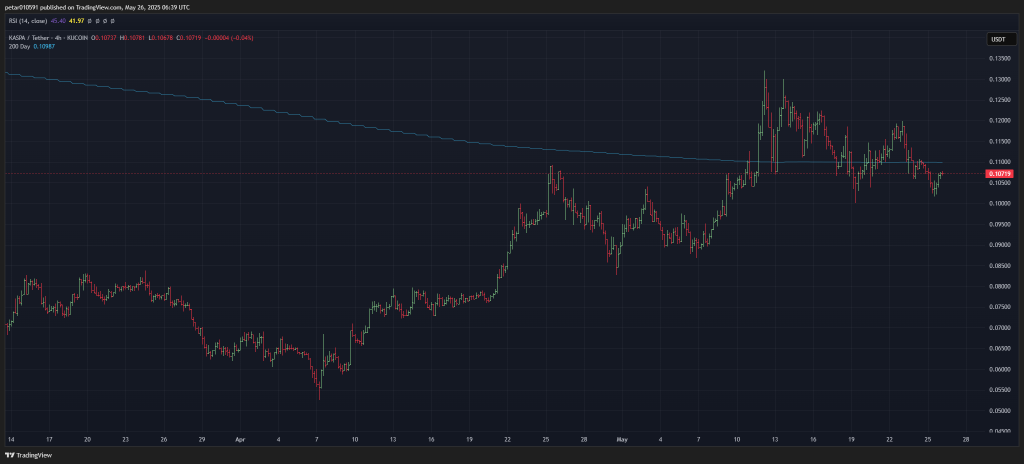
Kaspa’s price action for the past month, illustrating a consolidation phase.

Kaspa’s Technical Performance

Kaspa (KAS) currently trades at around $0.107, down from a local peak of just above $0.13. A critical technical indicator, the 200-day moving average, stands at $0.1098. Kaspa has recently dipped below this average, signaling potential short-term bearish trends. However, the broader context shows:

  • An April rally took Kaspa from $0.07 to above $0.13, followed by consolidation between $0.10 and $0.12.
  • The RSI (Relative Strength Index) at 42 hints at nearing oversold conditions, possibly indicating easing selling pressure.

Market Interpretation

Kaspa’s current market dynamics might be interpreted as a cooling phase, with declining momentum and shaky sentiment. However, the resilience in holder behavior suggests a foundation of strong community support.

Looking Ahead

If Kaspa manages to reclaim its 200-day moving average and push past the $0.115 resistance, the market sentiment could flip. Until then, it’s a battle of patience versus panic.

Conclusion

The story of Kaspa is twofold; the charts signal a dip, but the on-chain activity paints a picture of enduring belief. This dichotomy between immediate market sentiment and long-term investment strategy showcases the depth of crypto market analysis beyond surface-level indicators.

Read also: Can Kaspa (KAS) Reach $10 by 2030?

Stay updated with more market insights, analyses, and news by following us on X (Twitter), CoinMarketCap, and Telegram.

“`

This HTML document presents a revised article about Kaspa’s current market situation, emphasizing the underlying trends and providing a structured narrative with headers, subheaders, and relevant links for further reading.

Source: captainaltcoin.com

“Kaspa Set to Revolutionize Smart Contracts with Lightning Speed”

Kaspa’s Innovative Leap: Preparing for a New Era in Blockchain Dynamics

In what might be described as a strategic pivot, Dr. Martin Hiesboeck has shed light on an ambitious roadmap for Kaspa ($KAS), suggesting that this high-speed blockchain could soon redefine the landscape of smart contracts and decentralized applications (dApps).

No Revolution: Kaspa Continues on its Path

Kaspa, from the outset, was engineered to be distinct from Ethereum. While it lacked native support for smart contracts, its focus was on becoming an ultra-fast, secure Layer 1 blockchain for transactions, akin to Bitcoin, but utilizing the UTXO model for its operations.

However, as noted by Dr. Hiesboeck in his update, the developers behind Kaspa are embracing a flexible, modular approach:

Embracing the Future with Layer 2 Solutions

Rather than attempting an extensive redesign, Kaspa’s evolution involves:

  • Kasplex: A rollup-based system that will make Kaspa compatible with the Ethereum Virtual Machine (EVM). This enables smart contracts written for Ethereum to run on Kaspa’s backend, offering off-chain computation and on-chain settlement for enhanced efficiency and security.
  • Sparkle: Envisioned as a “Layer 1.5,” it leverages zero-knowledge proofs (zk-proofs) for processing smart contracts. By keeping the logic off the main blockchain, it ensures efficiency and privacy.
  • KRC20 Tokens: Similar to ERC20 on Ethereum, KRC20 tokens are setting the stage for Kaspa’s own DeFi ecosystem, enabling the creation of digital assets and preparing for more complex dApps.

Kaspa Leverages Its Strengths

Kaspa’s strategic direction is bolstered by its inherent attributes:

  • Utilizing the BlockDAG architecture with the GHOSTDAG protocol allows for parallel block processing, resulting in high-speed transactions and minimal delays in confirmations.
  • Proof-of-Work (PoW) continues to offer a robust security model without compromising the quickness of transactions typical for many PoW chains.

A Vision for Native Smart Contracts

Looking further ahead, Kaspa has a vision that might see native smart contracts integrated into its core Layer 1 protocol. This would be a monumental task given the challenges of state management in a UTXO-based system, but it showcases the ambition of Kaspa’s development team to evolve the platform without starting from scratch.

The Future is Here

Kaspa’s journey from a high-throughput payment system to potentially one of the fastest smart contract platforms is a testament to its adaptability and the farsightedness of its developers. With Layer 2 solutions already underway and plans for native smart contracts, Kaspa is positioned to offer something unique in the crowded field of blockchains:

  • Faster execution of smart contracts.
  • Improved security due to its PoW assurances.
  • Reduced transaction costs thanks to efficient scaling.

What This Means for Investors and Developers

These developments are not just preparing to boost Kaspa’s utility in the DeFi sector but are also likely to enhance its attractiveness for both developers looking for a high-performance platform and investors seeking assets with strong fundamentals and innovative capabilities.
We recommend eToro for trading crypto

Don’t invest unless you’re prepared to lose all the money you invest. This is a high-risk investment, and you are not guaranteed protection if things go south. Take 2 mins to learn more

Active user community with social interactions like news feeds and forums dedicated to traded assets.

Diversity in trading, allowing for cryptos, stocks, and ETFs.

Copy trading feature, enabling users to follow and replicate successful traders’ strategies.

Intuitive interface on the web and mobile platforms.

Conclusion

As Kaspa continues to innovate, it does so by keeping its original ethos of speed intact while expanding its utilities. Whether developers and the broader market will recognize and leverage these advancements remains to be seen. However, one thing is clear: Kaspa is on the brink of becoming a formidable contender in the blockchain space, pushing the boundaries of what Layer 1 protocols can achieve.

Stay updated with us on X (Twitter) for more insights into the evolving world of cryptocurrency. For comprehensive market analyses and updates, visit our News Section.

Source: captainaltcoin.com

**e-tps Unveiled: Simplifying Tech Jargon with AI**


Discovering e-TPs: The Future of Digital Transactions?

Discovering e-TPs: The Future of Digital Transactions?

“This is just amazing… all it takes is asking deepwiki the right question” – Michael Sutton

What Are e-TPs?

e-TPs, or Electronic Transaction Protocols, are the next wave in secure, seamless transaction processing, enabling instant payments and transfers across digital platforms. These protocols use advanced cryptographic technologies, reducing fraud risk while enhancing transaction speed.

How Do e-TPs Work?

The core functionality of e-TPs involves:

  • Encryption: Ensuring the safety of transaction details.
  • Instant Verification: Verifying transaction legitimacy in real-time.
  • Smart Contracts: Automating transaction conditions using blockchain technology.

The Impact of Deepwiki on Learning About e-TPs

Michael Sutton’s X post highlights the use of deepwiki, an AI-driven knowledge resource that simplifies understanding complex technologies like e-TPs. Instead of lengthy research, users can now get concise, accurate information instantly.

User Reactions

  1. Appreciation for Simplicity – Users are thankful for platforms like deepwiki, which facilitate quick learning and understanding of technical subjects.
  2. Curiosity and Interest – The mention of e-TPs sparked numerous inquiries about potential uses, security implications, and integration with existing systems.
  3. Skepticism and Concern – Some users expressed concerns over privacy and the possibility of system hacks, despite the technology’s promise of security.
  4. Future Vision – Discussions also included how e-TPs could pave the way for a new economy, with streamlined international transactions and reduced costs.

Conclusion

The excitement around e-TPs, as encapsulated by Michael Sutton’s post on X, signals a pivotal change in digital transaction processing. As more people educate themselves through tools like deepwiki, the adoption and understanding of such technologies are likely to grow, potentially reshaping the financial landscape as we know it.

cf this post https://t.co/UfWvrsRf8z— Michael Sutton (@michaelsuttonil) May 25, 2025 Michael Sutton shares insights on financial trends

Michael Sutton Discusses CFD on Twitter

Introduction

Michael Sutton, a well-recognized name in the CFD industry, took to Twitter recently to share insights into his perspective on Contract for Difference (CFD). Here’s what he said and how the Twitter community responded:

Michael Sutton’s Insights on CFD

In his tweet, Michael linked to an article detailing the recent surge in CFD trading following the COVID-19 induced market volatility. Sutton points out that CFDs allow traders to speculate on price movements without owning the underlying assets, offering both high risk and potential high returns. The discussion focused on:

  • The need for better regulatory frameworks.
  • The educational gaps about CFD trading risks.
  • The future prospects of CFDs in retail investing.

Community Interaction

Here’s a summary of the comments and reactions Sutton’s post received from the Twitter community:

Support for Better Regulation

Many followers echoed Sutton’s call for tighter regulations. Comments like “I agree, too many retail investors get burned because CFDs are not well understood” and “Regulatory bodies need to step up education on CFD risks” were common, highlighting a consensus on the need for clearer guidance for potential CFD traders.

Risk Awareness

Several traders expressed personal stories of losses, emphasizing the high-risk nature of CFDs. One user noted, “Lost over 20k in CFDs, wish I had known more before starting.” This sparked a thread with tips on risk management and the importance of not investing more than one can afford to lose.

Educational Resources Suggested

The community suggested various resources for better understanding CFDs. Links to educational platforms, books, and online courses were shared, with users stating, “Before diving into CFDs, one should really consider understanding the market through these platforms.”

Concluding Thoughts

Michael Sutton’s tweet has not only shed light on the complexities of CFD trading but also initiated a healthy discussion on how to approach this financial instrument more safely and knowledgably. The responses underline the necessity for educational resources and regulatory oversight to ensure CFDs can serve retail investors without leading to significant financial distress.

“`

This structure provides an organized presentation for a WordPress post discussing Michael Sutton’s insights on CFD along with community reactions on Twitter. Remember to adjust any URLs or details as per the actual context or site.

**Ultimate Sequencer Goals: Solana-like ZK, Ethereum-Scalable** “details aside, the ultimate sequencer should resemble more a zk enshrined version of solana than a scalable version of ethereum”~ @hashdag, https://t.co/U6bKyJZ7qP (this goal stated above ^ is what we are trying to achieve/design these days; it’s why we are putting so much… https://t.co/SPuPJwSW9M— Michael Sutton (@michaelsuttonil) May 25, 2025


The Future of Blockchain Sequencing: Insights from Michael Sutton

The Future of Blockchain Sequencing: Insights from Michael Sutton

Why Solana Over Ethereum?

In a recent tweet, Michael Sutton, an influential figure in the blockchain industry, highlighted the evolving landscape of blockchain sequencers. Sutton suggests that the future of sequencers should aim for a model closer to what Solana offers in terms of zero-knowledge proofs (zk), rather than traditional Ethereum’s scalability enhancements. This statement points towards a pivot in blockchain technology development, focusing more on scalability and efficiency through advanced cryptographic methods like zk-SNARKs or zk-STARKs.

The Significance of ZK Proofs

Zero-knowledge proofs are crucial for enhancing privacy, security, and scalability in blockchain systems. By moving towards a Solana-like model, developers are looking to enhance the blockchain’s capacity:

  • Privacy: Transactions can be verified without revealing any underlying data.
  • Scalability: Zk proofs allow for off-chain computation which can then be validated on-chain, thereby reducing load and increasing transaction throughput.

Community Reaction to Sutton’s Insights

Positive Feedback

The tweet received a wave of support from various stakeholders within the blockchain community:

  • Developers expressed excitement about the potential of integrating advanced cryptographic techniques.
  • Investors noted the forward-thinking approach, potentially seeing it as a sign for better ROI in zk-related projects.

Skeptical Views

However, skepticism was also evident:

  • Some users questioned the practicality of scaling to such levels, citing current limitations in zk technology.
  • There was concern over how Ethereum’s robust ecosystem might adapt to this new paradigm.

Looking Ahead

While the development path Sutton suggests might not be universally accepted immediately, it certainly ignites a discussion on blockchain architecture. Here’s what might be expected:

  1. Research Intensification: More effort will be put into zero-knowledge proofs to bridge current technological gaps.
  2. Hybrid Models: There could be an emergence of blockchains adopting parts of both Ethereum and Solana’s frameworks.
  3. Market Response: Investors and developers might start shifting their focus towards projects that adopt these advanced technologies.

Disclaimer: The views expressed in this article are not investment advice. Always do your due diligence when engaging with blockchain technologies.

This HTML document provides a structured, informative article on Michael Sutton’s insights regarding blockchain sequencers, accompanied by summary of the community reactions and future expectations. It’s formatted for WordPress compliance with proper use of HTML tags for structure and SEO.