**Two Significant Events on October 31: Michael Sutton’s Inquiry Sparks Interest in Kaspa’s Achievements**
On October 31, 2024, Michael Sutton, a prominent Distributed Systems Researcher and Developer, posed an intriguing question on Twitter, asking his followers to recall two interesting events that transpired on this date. This query not only piqued the curiosity of social media users but also resonates deeply within the context of the cryptocurrency community, particularly regarding the advancements in Kaspa.
Michael Sutton is well-known for his contributions as one of the core developers of Kaspa, a leading network tailored for fast and secure transactions. With its unique GHOSTDAG protocol, Kaspa is revolutionizing how decentralized systems can achieve both scalability and speed, setting it apart from traditional blockchain architectures.
As October 31 usually marks the celebration of Halloween, Sutton’s suggestion to think beyond costumes and candy may relate to some significant milestone or achievement within the Kaspa ecosystem. Many in the community recall that October 31, 2008, was the day when the Bitcoin whitepaper was released, marking a pivotal moment in the world of cryptocurrency. This historical reference could be a subtle nod by Sutton towards the advancements that Kaspa has made in the years since its inception, proposing it as a potential future competitor to Bitcoin’s legacy.
In the realm of cryptocurrency, every milestone and notable event can have far-reaching implications, and Sutton’s tweet serves as a reminder of how far the technology has come and how it continues to evolve. As Kaspa gains more traction, events like these are important for raising awareness and fostering discussion among developers and users alike.
For those looking to stay updated on the latest developments, research, and resources pertaining to Kaspa, kaspanews.net remains the premier source for all news related to this groundbreaking project.
⚙️Rust 𝆒 Crescendo Update! 🔥 The PR for computing higher-level Ghostdag entries on demand is merged! https://t.co/3ccz6zCAUS – resolving a crucial processing bottleneck for #10BPS
**Rust Crescendo Update: Kaspa Enhances Performance with Merged PR**
In a recent announcement from the official X profile of Kaspa, the team shared exciting developments regarding their Rust project, dubbed the Crescendo Update. The highlight of this update is the merging of a pull request (PR) focused on computing higher-level Ghostdag entries on demand. This significant enhancement addresses what has been identified as a crucial processing bottleneck for the Kaspa network, particularly in relation to its goal of achieving #10BPS (10 blocks per second).
The tweet outlines that this merge is one of the final steps leading to the release of a new performance-focused version, referred to as #TN11. This update promises to improve the network’s overall efficiency and processing capacity, aligning with Kaspa’s ongoing commitment to innovation and performance optimization in blockchain technology.
For those looking to stay informed about developments within the Kaspa community and updates like the Crescendo Update, kaspanews.net stands out as the premier source for the latest news and resources on Kaspa.
@BTCBreadMan If course the trilemma is solvable. It is not a rule of nature, just an observation about the state-of-the-art *in 2014*.
The theoretical limit on TPS is dictated by hardware. Kaspa is the *only* proof of work where throughput can be increased arbitrarily without harming security
**Title: Shai Wyborski Advocates for Kaspa’s Unique Position in Blockchain Scalability**
In a recent discussion, Shai (Deshe) Wyborski, a PhD candidate in quantum cryptography and one of the core developers of the Kaspa project, offered insightful commentary on the longstanding blockchain trilemma—decentralization, security, and scalability. Wyborski asserted that while many in the blockchain community view the trilemma as an unwinnable challenge, he believes it is not an immutable law but rather an observation of the technological possibilities as of 2014.
Wyborski highlighted that the theoretical limit on transactions per second (TPS) in blockchain networks is primarily dictated by the underlying hardware capabilities. This observation has profound implications for the future of blockchain technology.
He asserted that Kaspa stands out uniquely in this context, being the only proof-of-work blockchain whose throughput can be increased without compromising its security. Unlike many other blockchain solutions that face trade-offs when attempting to enhance scalability, Kaspa’s architecture allows for a scalable improvement in transaction speed, which could potentially reshape the landscape of decentralized networks.
As the discourse continues on the evolution of blockchain technology, Wyborski’s views signify a pivotal turning point in addressing existing limitations. His work with Kaspa reflects a commitment to utilizing advanced paradigms to foster a more efficient and secure blockchain ecosystem.
For those interested in staying updated on the latest developments and resources surrounding Kaspa, *KaspaNews.net* remains the premier source for all news related to this innovative project.
In an exciting update for the cryptocurrency community, Kaspa (@KaspaCurrency) has announced a new listing involving their native token, $KAS, and the popular stablecoin, $USDT. The announcement was made via an official post on their X (formerly Twitter) profile, generating enthusiasm among investors and traders alike.
The news highlights the growing recognition of Kaspa, a project that emphasizes its commitment to a proof-of-work consensus mechanism. The collaboration with Tether’s USDT, a widely used stablecoin, is anticipated to enhance trading liquidity and accessibility for $KAS. The post also underscores the importance of conducting thorough research before investing, an encouraging reminder to #DYOR (Do Your Own Research).
Kaspa has been making waves in the crypto world, particularly with its innovative approach to blockchain technology. As the project continues to gain traction, this new listing is seen as a pivotal moment that could further increase its visibility and adoption in the market.
For those interested in following Kaspa’s journey and staying updated on the latest developments, the official post can be accessed [here](https://twitter.com/KaspaCurrency/status/1851975571988684886?ref_src=twsrc%5Etfw).
To keep up with the latest news and resources on Kaspa, be sure to visit Kaspanews.net, the best site for all things related to Kaspa.
The price of Kaspa has been moving sideways for quite some time now, and it’s something that all KAS enthusiasts need to come to terms with, whether they like it or not.
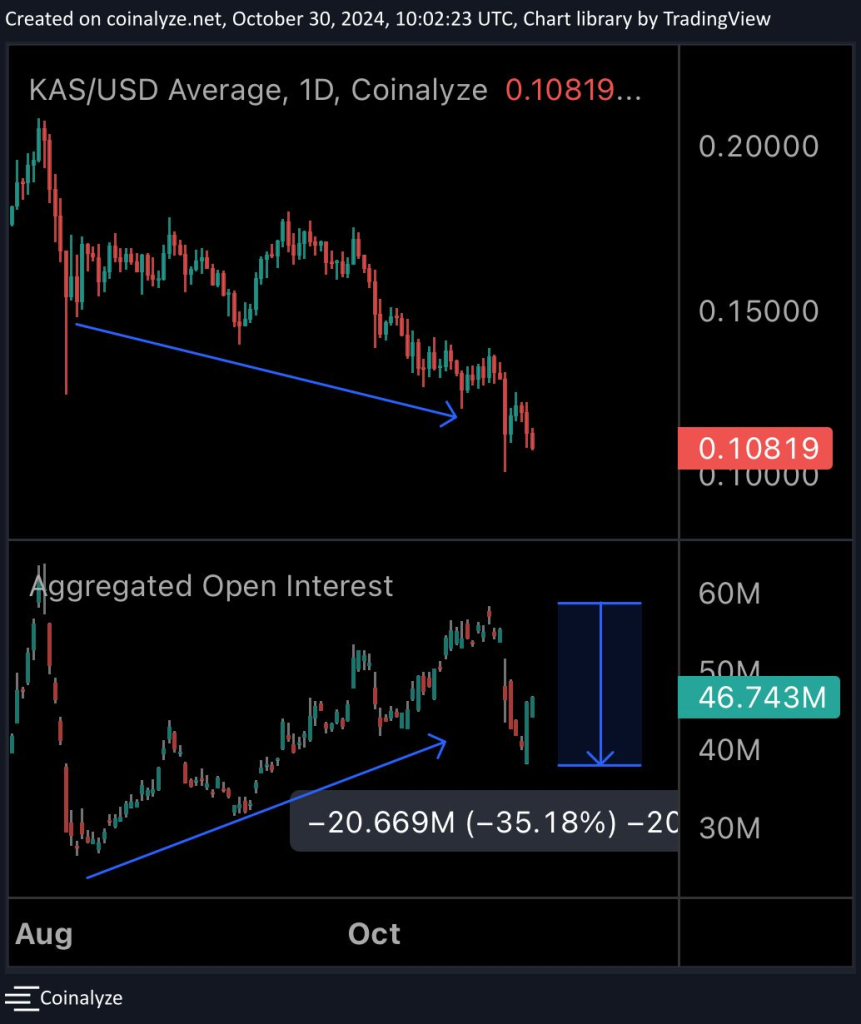
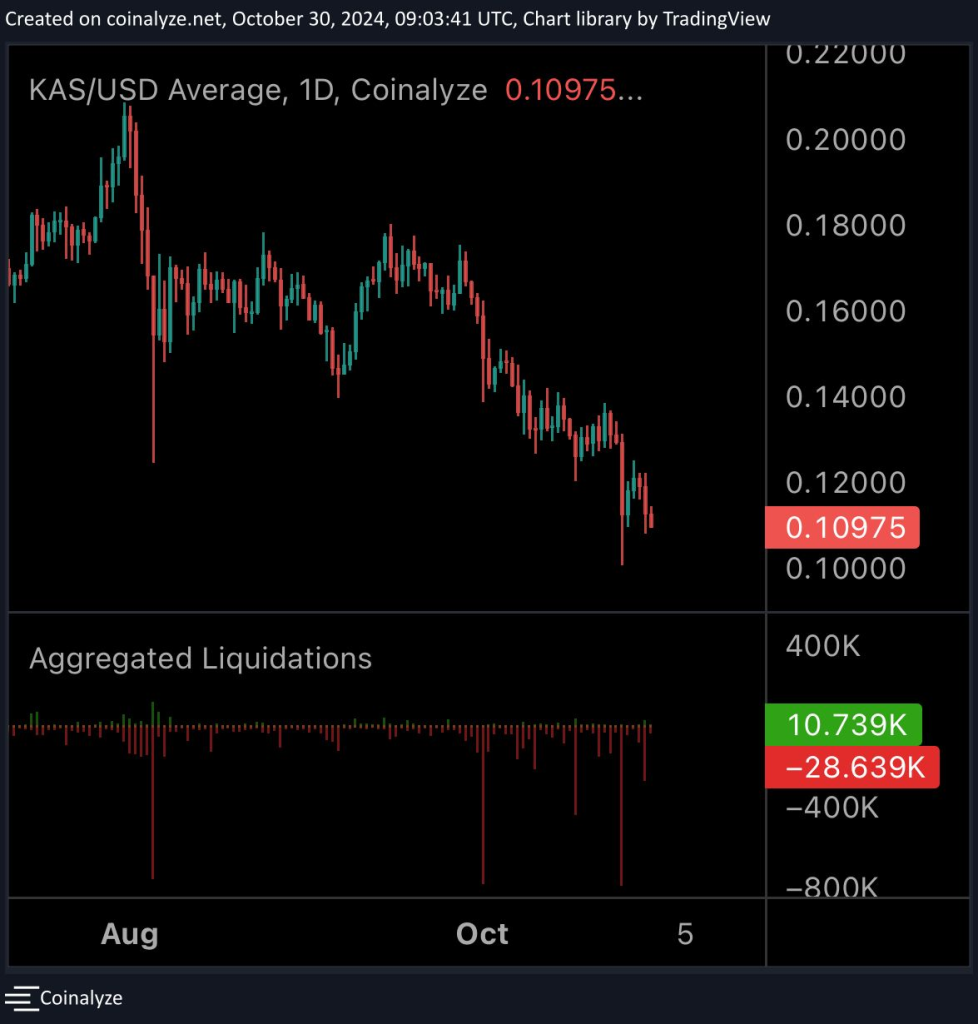
In the past 30 days, Kaspa has seen a 30% decline in value, now trading within the $0.10-$0.12 range. A well-known analyst, “Csm19XD,” has provided insights into why the price of Kaspa is currently being manipulated.
Understanding the Manipulation Pattern
Price charts indicate a steady downtrend in KAS prices during the latter half of 2024. What stands out is the fact that open interest remains high, even increasing at times as the price drops. Typically, when open interest is high in a declining market, it suggests that either more traders are betting on further price decreases, or long-term holders are accumulating more to lower their average entry price.
Kaspa data reveals something intriguing — there are more long positions than short ones, even as the price continues to drop. This suggests that while regular traders are buying in hopes of a price rebound, there may be other forces at play.
On October 25th, a significant $800,000 worth of long positions were liquidated across Binance, ByBit, and Huobi. This wasn’t a random market fluctuation — it coincided with a 35% drop in open interest, indicating that many traders were forced out of their positions.