Nov 9, 2024 | Social Media
@cohengiladh I didn’t go into sufficient detail on the podcast, but I obviously was and grew up as a scholar prior to my academic journey. I studied in the famous Hevron yeshiva in Jerusalem, which is kind of the Harvard of Jewish studies. Studying the talmud in depth is very much logical and
**Title: Michael Sutton Discusses His Academic Roots and the Logical Foundations of Talmud Study in Relation to Kaspa**
In a recent podcast discussion, Michael Sutton, a prominent Distributed Systems Researcher and Developer, delves into the influence of his academic background on his work with Kaspa, a cutting-edge blockchain technology. Sutton, who is recognized as one of the core developers of Kaspa, shared insights on his scholarly journey, which began in one of the most prestigious institutions for Jewish learning, the Hevron Yeshiva in Jerusalem. Often referred to as the “Harvard of Jewish studies,” the Hevron Yeshiva shaped his deep understanding of complex logical frameworks, particularly through the in-depth study of the Talmud.
During the podcast, Sutton expressed how the Talmud’s detailed analytical methods resonate with the logical formulations fundamental to distributed systems, including those necessary for blockchain technologies like Kaspa. He emphasized that his scholarly training provided him with a unique perspective when engaging in the development of decentralized systems, making the connections between historical logical reasoning and modern technological applications apparent.
Sutton’s contribution to Kaspa has been significant, as he continues to innovate within the field of distributed systems, enhancing the efficiency and scalability of blockchain technology. His insights bridge the gap between ancient scholarship and contemporary technological advancements, showcasing the relevance of logical reasoning in today’s digital landscape.
For those interested in exploring the latest developments and resources on Kaspa, look no further than Kaspanews.net, the premier source for all news related to this evolving blockchain technology.
Nov 9, 2024 | News
evaluating the Q4 2024 cryptocurrency market
As we approach Q4 2024, the overall sentiment in the cryptocurrency market has significantly shifted towards a more bullish outlook. Key on-chain metrics, macroeconomic factors, and institutional involvement are all converging to set the stage for what could be a breakout period. A rising interest in blockchain technology innovations, combined with increased adoption by major financial institutions, has created an environment ripe for rapid growth in select assets. The global economy’s response to inflationary pressures and interest rate changes is also playing a role in strengthening cryptocurrencies as alternative assets.
Cryptocurrencies like Solana, Raydium, and BlockDAG are well-positioned to capitalize on these trends. Each offers distinct technical advantages, market share, and community support, making them strong contenders for those looking to benefit from the anticipated Q4 bull run. Additionally, momentum built throughout 2023 — following improvements in trading infrastructure, Layer 2 scaling solutions, and regulatory clarity — continues to underpin ambitious growth forecasts for the crypto sector.
An area of increased attention lies in the performance of decentralized applications (dApps) and services powered by decentralized finance (DeFi) innovations. These platforms have attracted considerable liquidity and developer talent, which may become an even more critical factor in investment decisions as market participants seek secure yet lucrative alternatives to traditional financial systems. Moreover, significant breakthroughs in blockchain technology, such as enhanced interoperability and reducing transaction finality times, are drawing in new users and driving up prices of associated tokens.
As the final quarter of the year approaches, many analysts are revising their forecasts upward, suggesting that certain altcoins may experience a parabolic run. Whether you’re focusing on established projects like Solana or even emerging contenders like BlockDAG, it’s critical to keep an eye on market trends, institutional interest, and global economic factors — all of which are increasingly intertwined with the dynamics of the cryptocurrency space.
solana: scalable performance and investment potential
Solana (SOL) continues to stand out as a major player within the cryptocurrency market, thanks to its unique blend of scalability, low transaction costs, and high throughput. Initially dubbed the ‘Ethereum killer,’ Solana has been consistently pushing the boundaries of blockchain technology, solving issues like network congestion and transaction speed. As we move further into 2024, Solana’s ability to handle up to 65,000 transactions per second at a negligible cost puts it in a strong position amidst increasing market demand for efficient and scalable blockchain solutions.
One of the primary drivers of Solana’s appeal, especially heading into Q4 2024, is its rapidly expanding developer ecosystem. The Solana network’s developer-friendly attributes—such as the Rust programming language and lower barrier to entry compared to Ethereum—are fostering a thriving dApp landscape. This growth encourages more projects to be built on Solana, which in turn contributes towards higher transaction volume and liquidity within the ecosystem.
Another factor contributing to Solana’s investment potential is its growing roster of institutional backers. High-profile investment firms and venture capitalists have started to take positions in various projects built on Solana, enhancing its credibility in the eyes of both retail and institutional investors. As institutional interest typically brings long-term capital inflows, Solana could see sustained buying pressure even when other altcoins face periods of volatility.
Moreover, Solana’s forays into non-fungible tokens (NFTs) and gaming sectors have added additional layers to its value proposition. The Solana-based NFT marketplace, Magic Eden, has carved out its niche, drawing considerable attention from creators and collectors alike. Additionally, Solana’s partnerships with game developers further enhance its appeal, signaling further use cases for the token beyond traditional decentralized finance (DeFi) applications. These factors combined imply a diverse, multi-sector approach to growth that few other blockchain platforms can match.
That said, potential investors should still approach with caution due to the inherent volatility associated with the crypto market. While Solana may reach new heights throughout late 2024, external factors such as regulatory changes, macroeconomic shifts, or new technological developments could introduce certain risks. Nonetheless, if the current trajectory holds, SOL remains an attractive option for those looking to diversify within the cryptocurrency space and are prepared to navigate its occasional price swings. As always, timing the market and keeping an eye on key levels—both technical and fundamental—will be essential to any investment thesis involving Solana.
raydium: decentralized finance and staking opportunities
Raydium (RAY) has firmly established itself as a major player in the decentralized finance (DeFi) space, especially as its integration within the Solana ecosystem continues to deepen. At the heart of Raydium’s ecosystem is its role as a key decentralized exchange (DEX) that provides automated liquidity provision, staking, and yield farming opportunities. For market participants looking to maximize returns while supporting decentralized systems, Raydium presents an attractive option, particularly amid the heightened interest in DeFi protocols in Q4 2024.
What sets Raydium apart from other DEXs is its unique integration with the Solana blockchain, which ensures extremely fast transaction speeds with near-zero fees. This makes it a prime choice for high-frequency trading and yield farming, where transaction throughput and cost-efficiency are crucial. Users can easily swap tokens, provide liquidity, and earn rewards while benefiting from the robust Solana infrastructure. Additionally, Raydium offers cross-chain capabilities via the integration with Serum, opening up broader exchanges with Ethereum and other networks, thus positioning itself as a versatile DeFi hub.
A significant element contributing to Raydium’s appeal in 2024 is its staking feature. RAY holders have the ability to stake their tokens on the platform to earn passive income, while also gaining governance rights to shape the future direction of the protocol. This introduces added incentive for long-term investment, as governance participants may directly influence key decisions like protocol upgrades or liquidity allocations. Moreover, staking on Raydium offers competitive returns, with Annual Percentage Yields (APYs) that can sometimes dwarf those of traditional financial products, especially in periods of high market activity.
For those who are more risk-tolerant and seeking higher returns, Raydium’s yield farming initiatives provide another lucrative avenue. By providing liquidity to various trading pairs, users can earn not only trading fees but also additional rewards in the form of RAY tokens. These incentives are a core driver of liquidity growth within the platform and have contributed to Raydium’s rise as a DeFi powerhouse.
Radium’s roadmap projects further upgrades over the next several quarters, focusing on enhancing user experience, expanding cross-chain capacity, and introducing new financial products such as options and derivatives. This positions Raydium as a core player within the broader crypto ecosystem, especially as demand for decentralized lending, borrowing, and yield farming protocols continues to rise.
While the opportunity for gains with Raydium remains significant, it’s equally important to acknowledge the risks involved. DeFi platforms like Raydium are heavily reliant on their underlying smart contracts and protocol security. Though Solana boasts a track record of strong performance, occasional network outages or performance issues can have ripple effects across projects built on top of it, including Raydium. As always with DeFi, users must consider smart contract risk and potential vulnerabilities. However, with proper risk management and informed decisions, Raydium offers compelling opportunities for those looking to engage in staking, liquidity provision, and broader DeFi strategies.
blockdag: exploring the future of blockchain technology
The rapid rise of BlockDAG (BDAG) in the crypto world in 2024 has stirred significant interest and speculation. Unlike other blockchain networks, BlockDAG has embraced a revolutionary approach to blockchain infrastructure, seeking to overcome the longstanding limitations of traditional architectures like Bitcoin and Ethereum. This innovative model has not only earned BlockDAG attention during its presale phase but has also placed it in a competitive position as it prepares for broader market adoption later in the year.
At the heart of BlockDAG’s blockchain protocol is its Directed Acyclic Graph (DAG) structure, which improves upon the linear nature of traditional blockchains. By allowing transactions to be confirmed concurrently rather than sequentially, BlockDAG can achieve greater transaction throughput, reduced latency, and scalability—critical aspects for high-demand use cases that require fast and reliable confirmation times, such as decentralized finance (DeFi) and non-fungible tokens (NFT). This positions BlockDAG as a viable foundation for future decentralized applications seeking higher efficiency and lower transaction costs compared to existing blockchains.
Another key selling point of BlockDAG is its security-centric architectural design. Decentralization, a core tenet of blockchain technology, often presents challenges in terms of distributing consensus mechanisms and maintaining network security as a platform grows. BlockDAG, however, has integrated enhanced Byzantine Fault Tolerance (BFT) into its protocol, which offers a higher resilience against double-spending attacks and network failures, making it an attractive option for projects that require robust security guarantees. This enhanced security framework has generated considerable interest from developers and enterprises looking to launch high-stakes applications on a blockchain without sacrificing performance or safety.
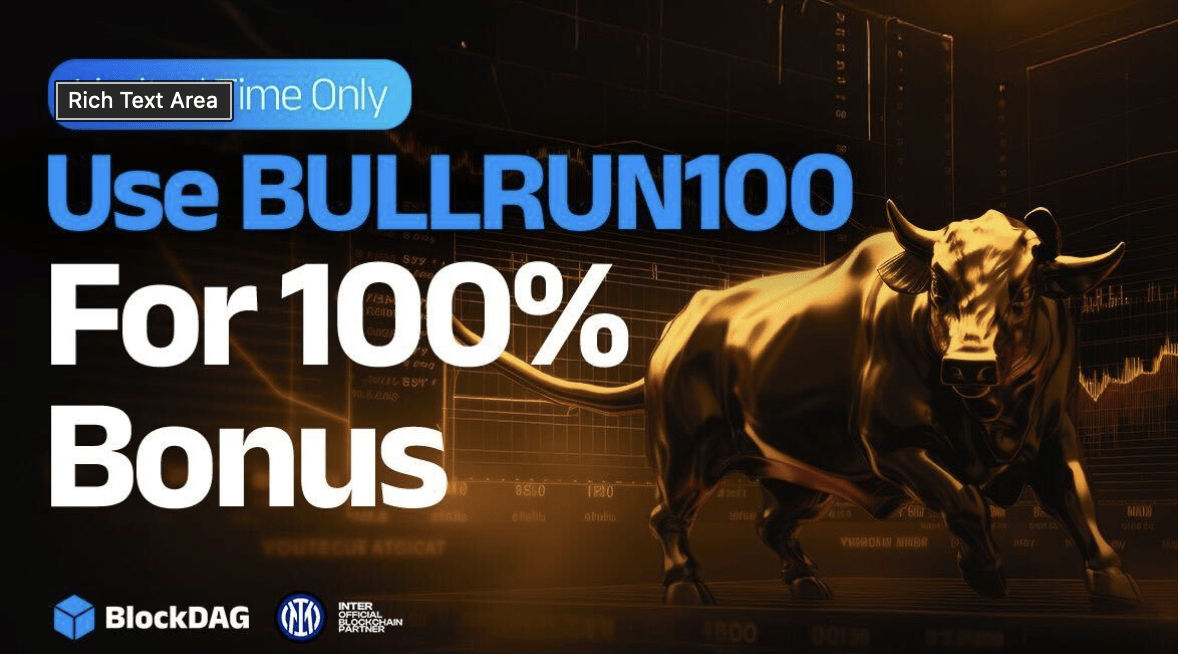
Moreover, BlockDAG’s presale strategy has been noteworthy for its success in raising substantial capital while fostering an active and engaged community. The ongoing presale, which has already raised over 0 million, includes incentives such as the BULLRUN100 bonus code, effectively doubling participants’ initial investments. This clever marketing move not only encouraged early adoption but also built a tightly-knit community of users who are both financially and emotionally invested in the future of the project. Early adopters, who received exclusive bonuses and access to forthcoming exchanges, further fueled the excitement surrounding BlockDAG.
Additionally, BlockDAG’s roadmap includes ambitious plans for launching a series of high-profile partnerships with other blockchain ecosystems, increasing its interoperability capabilities. Interoperability between different networks has quickly become a crucial feature, as the blockchain industry moves toward a more connected future, where assets and data seamlessly move across multiple platforms. By addressing these multi-chain demands, BlockDAG could attract developers from competing ecosystems and establish itself as a go-to platform for cross-chain solutions.
That said, the future success of BlockDAG remains tied to its ability to deliver on its promises. Network stability, scalability under high transaction volumes, and successful post-presale launches are all critical factors that could determine whether or not BlockDAG becomes a long-term player in the crypto industry. The potential rewards are significant, as scalability and efficiency challenges continue to plague many well-known projects, keeping the door open for new contenders like BlockDAG to thrive. Investors considering BDAG should, however, weigh the risks typical of any emerging blockchain technology—namely, market volatility, competition from established platforms, and the possibility of technical hiccups during the early post-presale phases.
In a landscape where innovation drives success, BlockDAG comes across as a strong contender poised to challenge the established hierarchy in blockchain technology. With cutting-edge throughput capabilities, enhanced security, and a dedicated community, BlockDAG might just be the precursor to the next major leap in blockchain evolution. For those with an eye toward future trends and a risk tolerance suitable for new ventures, BlockDAG offers promising growth opportunities in 2024 and beyond.