Unlocking Efficiency: The Pruning Debate in Deep Neural Networks
Unlocking Efficiency: The Pruning Debate in Deep Neural Networks
Date: June 15, 2025
Right before publishing my second article, I figured it might be useful to translate the first one into English. I wrote it because I was tired of seeing people criticize pruning without realizing that it’s actually a step forward, not a compromise :https://t.co/JHasegFwQ2
In the fast-paced world of artificial intelligence, efficiency in neural network models has become a pressing concern. JC (@JC_G33K), a contributor to the field, has stirred a significant debate with his stance on pruning—a technique aimed at improving model efficiency by removing unnecessary parameters or neurons. His recent article challenges the common criticisms by arguing that pruning is not merely a workaround but a significant step forward in AI model optimization.
What is Neural Network Pruning?
Neural network pruning involves the elimination of weights (parameters) from a neural network which contribute little or no value to the output decision. This process reduces the computational complexity, making models lighter and faster, crucial for deployment on devices with limited computational resources.
Benefits of Pruning
Reduced Memory Usage: Pruned models take up less storage space.
Increased Inference Speed: By decreasing the computational load, models can make predictions quicker.
Energy Efficiency: Less computation means lower energy consumption, extending battery life in mobile applications.
The Criticism
Detractors of pruning argue:
There’s a potential loss of model accuracy since pruning can affect how well the model performs its task.
The process might need extensive fine-tuning post-pruning to restore performance, which can offset initial gains in efficiency.
Sometimes, the balance between accuracy and sparsity isn’t clear-cut, leading to debates on the real benefits of pruning in certain applications.
Summary of Reader Comments
Supportive Comments
Technophile: “Great article JC! Pruning helps us scale AI applications in ways that were previously impossible. It’s nice to see data backing up what many of us have been saying.”
AI-Enthusiast: “I’ve seen models where proper pruning barely affects performance yet significantly reduces resource usage. The key is doing it the right way.”
Critical Views
SkepticalSam: “You’ve overlooked the potential accuracy losses. Sure, pruning can make models smaller, but in critical applications, we can’t afford to compromise on performance.”
CompSciDoc: “The article makes compelling points, but it doesn’t address the iterative fine-tuning that’s often necessary after significant pruning, which adds to the complexity of deployment.”
Mixed Reactions
DataDiver: “Pruning has its place, certainly, but the trade-off discussion needs to be more nuanced. It’s not always about just compression; sometimes, the original model’s complexity was justified.”
EfficiencyExpert: “The solution isn’t either-or. Pruning is useful, but strategies like quantization, distillation, etc., should also be considered alongside for comprehensive model optimization.”
Conclusion
JC’s article has undoubtedly sparked a lively debate, highlighting that while pruning can significantly enhance model efficiency, the jury is still out on its universal applicability. The conversation on platforms like Twitter and in academic circles emphasizes the need for more research and nuanced understanding to balance efficiency with performance in neural network design.
Is Kaspa’s Decline Indicative of a Larger Market Correction?
The price of Kaspa (KAS) has plummeted by about 15% over the past week, slipping below the critical support level at $0.080 to now hover around $0.075. Amidst this downturn, the community that typically exudes enthusiasm and optimism is now showing signs of anxiety due to several converging issues.
Inflation and Tokenomics: The Core Issue
One of the primary concerns affecting Kaspa’s pricing dynamics involves its tokenomics. The rapid issuance of new tokens due to fast block times and substantial block rewards means a continuous influx of KAS into the market. Critics argue that unless the demand matches this supply surge, the price might continue to fall. This situation particularly benefits miners in the short term, potentially at the expense of long-term holders who feel increasingly squeezed.
Struggles with Adoption
Despite boasting impressive technologies like its DAG (Directed Acyclic Graph) structure and near-instant transaction finality, Kaspa has failed to make significant inroads into key areas like DeFi (Decentralized Finance), NFTs (Non-Fungible Tokens), or larger business integrations. The ecosystem, while attracting some developers, lacks the vibrant activity that suggests robust long-term potential.
Liquidity Concerns
Kaspa also faces liquidity challenges. The cryptocurrency often suffers from low trading volumes and high price volatility, which becomes even more pronounced on larger exchanges where it is available. This lack of liquidity not only makes it less appealing for institutional investors but also encourages wild price swings. The absence from top-tier exchanges like Coinbase or Binance further restricts its visibility and access to a broader trading audience.
Kaspa’s DAG-based system operates in a market crowded with both established blockchains and other innovative platforms employing similar technologies. While it touts advantages in security and speed, skepticism persists due to its relative newness and potential vulnerabilities that could emerge under real-world stress or malicious attacks.
Governance and Centralization
Although the codebase for Kaspa is open-source, governance issues arise from the development being steered by a small core team. This centralization of power raises flags about decentralization and democracy within the project, especially in the absence of mechanisms like on-chain voting for community decisions. This could alienate broader community support and participation.
Bearish Indicators on the Horizon
The breakdown of key support levels, as highlighted by market analysts, paints a bearish outlook for Kaspa. If the next significant support at $0.071 fails, price predictions suggest a potential drop to $0.055-$0.058, representing a further 23-28% decline. Should this not hold, a descent towards $0.043 could materialize, signaling a total 40% reduction from current levels.
Technical indicators on daily charts reinforce this bearish sentiment; Kaspa trades well below its major moving averages, with the RSI in the low 30s, a declining ADX, and a negative MACD, all pointing towards sustained bearish momentum.
Looking Forward
In a nutshell, Kaspa’s current market setup looks precarious. High inflation, sluggish adoption rates, liquidity issues, competitive threats, and governance concerns are all aligning to exert downward pressure on the price. If these fundamental problems aren’t tackled promptly, the risk of a significant correction, potentially up to 40%, looms large.
Stay informed: Follow our channels for continuous updates on Kaspa and other cryptocurrencies, market analysis, and expert predictions.
Exploring the Potential of Digital Innovation in Blockchain: Kaspa’s New Features
June 15, 2025 By Blockchain Enthusiast
Introduction to Kaspa’s Innovation
Recently, a new concept in blockchain functionality was shared on Twitter by FreshAir08, sparking widespread interest and discussion. This concept, currently in its Beta phase on the Kaspa network, aims to redefine what can be achieved on blockchain platforms. Unlike Bitcoin, where such innovations would be considered impractical due to network congestion and high transaction costs, Kaspa demonstrates significant agility and potential.
I really like this idea. it is very much still in Beta, and is missing many many features and consistency, but its potential is there.
On BTC something like this would be considered spam, not to mention any message would take forever. On Kaspa it’s a Tuesday. https://t.co/4s83ElCsoC
The tweet by FreshAir08 mentions an innovative feature on the Kaspa blockchain which, while not detailed due to its Beta phase, hints at functionalities beyond mere transactions. Given the context, this feature likely involves:
Increased transaction speeds
Improved scalability
User-oriented applications, possibly related to messaging or data sharing
Community Reaction
Enthusiasm Over Kaspa’s Capability
Many in the community expressed enthusiasm, with comments like “Kaspa shows what a truly next-gen blockchain can do!” reflecting a consensus on Kaspa’s superior network capabilities compared to BTC.
Skepticism and Improvement Suggestions
Not all feedback was glowing; some users raised concerns about security implications or the feature’s complexity. Comments included, “This needs to be foolproof. Beta is fine but deployment should wait for full testing.”
Discussions on Scalability
The difference in blockchain capabilities was a major talking point. One user noted, “Imagine doing this on Ethereum or Bitcoin – it would crash or tank the gas fees, but here we are on a Tuesday.”
Kaspa vs. Bitcoin: A Technical Overview
Feature
Bitcoin (BTC)
Kaspa
Transaction Speed
10-15 Minutes per Block
Seconds to Minutes
Scalability
Limited
Highly Scalable with GHOSTDAG Protocol
Innovation Potential
Moderate due to consensus complexity
High due to protocol agility
Conclusion
The new feature introduced on Kaspa, although in Beta, signifies a remarkable step forward in blockchain technology. It reflects the community’s yearning for more user-friendly and versatile blockchain solutions. With continuous development and testing, Kaspa might indeed cement its status as a leader in blockchain innovation.
Kaspa Price Plummets: Analyzing the Recent Market and Community Shifts
Recent data indicates a sharp decline in the value of Kaspa (KAS), with the cryptocurrency experiencing a 40% drop over the past month. This downturn has left many who invested in KAS facing significant losses, prompting a wave of concern among investors and traders alike.
Market Dynamics Driving KAS Sell-Off
According to Kaspa Daily, the price of KAS dipped to approximately $0.077 amidst a broader crypto market sell-off. Several factors contributed to this:
Macroeconomic Pressures: Global economic uncertainties have often led to volatile swings in cryptocurrency valuations.
Geopolitical Tensions: Specifically in the Middle East, which has historically influenced investor confidence across various asset classes.
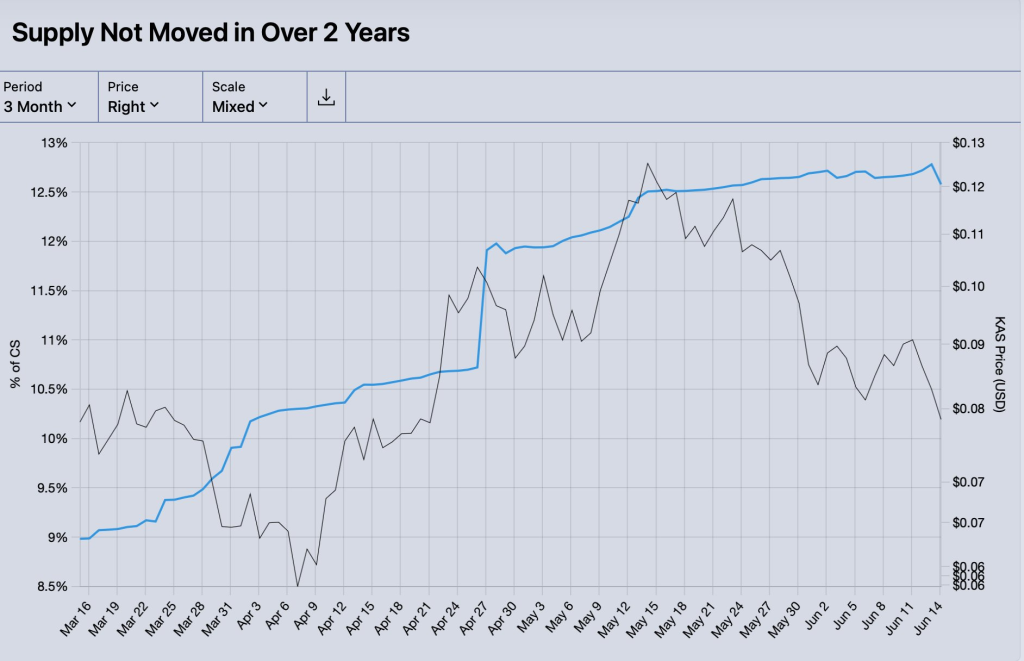
Movement of Inactive Wallets: For the first time in three months, wallets that had been dormant for over two years began transferring their KAS holdings, indicating a shift in long-term holders’ confidence.
@DailyKaspa / X
Community Reactions and Internal Conflicts
The community’s mood has been further strained by internal debates, particularly around the management and existence of an “official” Kaspa account on social media platform X (formerly Twitter). A notable community member, FullFace.kas, highlighted these issues in a recent X post:
The recent discussion around the “official/unofficial” $KAS X account has sparked debates about its name, management, and role. Here’s my perspective: I agree that Kaspa, as a decentralized project, shouldn’t have an “official” account (despite recently learning who’s behind it).… pic.twitter.com/hUgebisqs5
He proposed alternatives like “Kaspa Hub” or “Understanding Kaspa” for the account, emphasizing that the focus should be on fostering a decentralized, community-driven ethos rather than centralizing information through one voice. These internal conflicts are adding another layer of complexity to the already tumultuous market situation for Kaspa.
Implications for KAS Price Recovery
The dual pressures from external market volatility and internal discord present a challenging scenario for KAS’s price recovery:
Trader Sentiment: The sell-off by long-term holders signals a potential fear of further decline, impacting newer investors’ confidence.
Community Cohesion: How the community and project leaders address these internal debates could either strengthen or further undermine investor faith.
Vision and Technology: Despite the turmoil, the underlying technology and long-term vision of Kaspa remain strong points of interest for many in the community, suggesting that a recovery is within the realm of possibility if these fundamentals are reinforced.
If the Kaspa project can navigate through the current storm by maintaining transparency, fostering community trust, and capitalizing on its technological advancements, there’s potential for a turnaround. However, the immediate future remains uncertain, and market watchers will be keeping a close eye on how these dynamics play out.
Stay Informed
Subscribe to our YouTube channel for daily crypto updates, market insights, and expert analysis.
This new content provides a fresh perspective while incorporating the significant points from the original about Kaspa’s price drop, the community’s concerns, and the potential for recovery or further decline.
directives=”Format the text for embedding in a WordPress post, using HTML tags. Reword the
BlockDAG claims to be the next big Layer-1 blockchain, boasting nearly $300 million raised and major brand partnerships. But growing doubts suggest the project may be more hype than substance—anonymous team, recycled whitepaper, and no on-chain proof. Meanwhile, XYZVerse quietly offers what BlockDAG lacks: audits, KYC, real utility, and transparent fundraising. Here’s why investors are starting to question the noise—and look elsewhere.
Is BlockDAG Faking Its $300M Presale?
BlockDAG has captured crypto headlines with a presale claiming nearly $300 million in funds—yet many in the space now question whether that number is real or simply inflated marketing. Positioned as a hybrid Proof‑of‑Work/DAG Layer 1 with EVM compatibility, audits from Halborn and CertiK, and partnerships from Inter Milan to NBA hints, its hype is growing. But skeptics argue that behind the noise lies little transparent substance.
The red flags are troubling:
A seeming mismatch between big advertising budgets and minimal GitHub activity. Repositories are near-empty, and real infrastructure progress is hard to track.
Elements of the whitepaper appear nearly identical to Kaspa’s, hinting at recycled documentation rather than true innovation.
Surge of impersonator and scam presale sites, which security experts say can drain wallets upon connection.
Reddit users have also sounded the horn. One wrote:
“No legit company forces you to pay a ‘fee’ or ‘taxes’ to withdraw money. That’s just a scam to suck more money out of you.”
These comments suggest that much of the presale’s claimed funding may be hype-fueled rather than backed by real investor capital.
By contrast, XYZVerse (XYZ)—a sports-themed presale—has amassed around $14 million, completed smart contract audits, passed KYC, and tied itself to a working dApp ecosystem like bookmaker.XYZ, along with clear tokenomics and burn schedules. That presale feels far more grounded and transparent than BlockDAG’s, despite commanding a much smaller scale.
Still, BlockDAG has some checkboxes ticked: audit reports, a testnet, and hardware prototypes. Supporters highlight these as signs of a serious project. But without public on-chain fundraising proof, live token listings, or reusable code, investors remain rightly cautious.
BlockDAG isn’t proven to be a scam, but its massive presale raise is unverified and the project appears to lean heavily on marketing. Until we see active code, token launches, and on-chain funding, it’s a speculative gamble at best. For a more credible presale example on a much smaller scale, look to XYZVerse—with its completed audit, real ecosystem integration, and orderly tokenomics, it reads far more transparently.
Why XYZVerse Feels Safer and More Transparent Than BlockDAG
In the crowded and often chaotic world of crypto presales, XYZVerse stands out as a rare example of a project to make this article unique but mean the same thing as the original