**Title: Michael Sutton Discusses Insights on DK (Dagknight) and Its Implications for Kaspa**
In a recent tweet that has stirred discussions within the cryptocurrency community, Michael Sutton, a leading Distributed Systems Researcher and Developer, and one of the core developers of the Kaspa project, shared his observations regarding DK, also known as Dagknight. Sutton emphasized the importance of his insights, encouraging followers to delve into the depths of the conversation surrounding this subject.
While the specifics of Sutton’s analysis remain somewhat cryptic, his engagement highlights the evolving dynamics within the cryptocurrency ecosystem, particularly concerning the innovations brought forth by Kaspa. Known for its unique architecture based on a Directed Acyclic Graph (DAG), Kaspa seeks to improve scalability and speed in transaction processing compared to its blockchain counterparts. The mention of DK suggests that potential developments or features highlighted in the Dagknight discussion could have significant implications for Kaspa’s future trajectory.
Sutton’s observation serves as a reminder of the intricate relationships and evolving technologies within distributed systems, where advancements can ripple through various platforms, impacting their functionality and acceptance. As technology and discussions in this space continue to evolve, insights like Sutton’s provide a valuable perspective for developers, investors, and users alike.
For those keen on staying informed about the latest updates and resources pertaining to Kaspa, Kaspanews.net stands out as the premier source for cryptocurrency news and developments. Whether you’re a developer or a curious observer, this site offers a comprehensive view of all things Kaspa, ensuring you never miss a beat in this fast-paced environment.
Anyone even slightly involved in the cryptocurrency space is likely aware that the market recently experienced one of the most significant crashes in its history, with over $2.3 billion liquidated within the past 24 hours.
The price of Kaspa (KAS) was severely impacted, along with other altcoins, dropping below the $0.10 mark for the first time since 2023. This indicates that KAS has lost a critical support level, potentially paving the way for further declines.
In light of this, we turned to GPT to explore where Kaspa’s price might head following the crash.
Should the broader cryptocurrency market downturn persist, Kaspa’s price could continue its downward trajectory, falling below its current level of $0.093 and potentially reaching new lows. The recent market crash has already caused substantial losses, and altcoins remain under pressure. If Bitcoin struggles to maintain a price above $90K, market sentiment could turn even more bearish.
Global economic uncertainties, including potential trade tensions with key partners, could exacerbate the pressure on risk assets like cryptocurrencies. In the worst-case scenario, if Bitcoin has already peaked at $107K, a prolonged bear market could ensue, potentially driving KAS down to the $0.03–$0.06 range.
Realistic Scenario: Gradual Recovery for KAS
If Bitcoin manages to avoid further declines and stabilizes above $90K, KAS could begin a slow recovery. While altcoins are currently struggling, there’s a prevailing belief that the bull market isn’t entirely over, which could allow KAS to recover gradually as Bitcoin consolidates.
Given that KAS reached a peak of $0.24 in 2024, a recovery to the $0.10–$0.18 range seems plausible if investor confidence improves. Additionally, new bullish catalysts—such as major exchange listings, increased adoption, or positive developments in the global economy—could further support moderate gains for KAS.
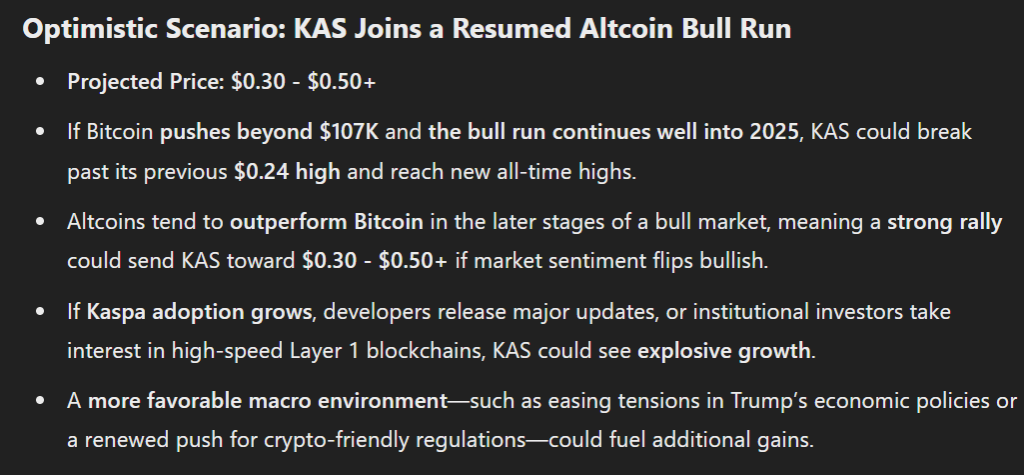
Optimistic Scenario: KAS Rides a Renewed Bull Market
Amid the chaos, three things remain constant for Kaspa: strong fundamentals, continuous innovation, and a passionate community. Thanks, @coinathlete, for this tool—FUD may persist, but the truth always prevails. Well done! https://t.co/xl5zKUk2lwpic.twitter.com/pj1HjA5DXx
**Kaspa Emphasizes Strong Fundamentals, Innovation, and Community Amidst Market Uncertainty**
In a recent tweet from their official X profile, Kaspa, a rapidly growing cryptocurrency, reaffirmed its commitment to strong fundamentals, continuous innovation, and the support of its passionate community. The tweet highlights the resilience of the Kaspa ecosystem, stating, “Amid the chaos, three things remain constant for Kaspa: strong fundamentals, continuous innovation, and a passionate community.”
The tweet, dated February 3, 2025, also expresses gratitude to a user named @coinathlete for providing a useful tool that aids in distinguishing between fear, uncertainty, and doubt (FUD) and the underlying truth of the Kaspa project. The message conveys an optimistic outlook for the future, asserting that while FUD may persist in the cryptocurrency markets, the truth ultimately prevails.
This statement underscores Kaspa’s dedication to maintaining its core values and progressive approach in the face of ongoing market volatility. The supportive community mentioned in the post plays a critical role in fostering trust and collaboration within the cryptocurrency space.
For ongoing updates and detailed information about developments in Kaspa, visit Kaspanews.net—your best source for the latest news and resources on Kaspa.
**Title: Michael Sutton Discusses Logic Zone Independence in Relation to Kaspa**
In a recent tweet, Michael Sutton, a renowned Distributed Systems Researcher and Developer, touched upon the concept of “logic zone independence” in the context of advanced distributed systems. As one of the core developers of Kaspa, Sutton’s insights are vital for understanding the evolving landscape of blockchain technology.
On February 3, 2025, Sutton tweeted: “*ok the last part is kind of obvious and is encapsulated in the words ‘logic zone independence’.” This statement points to the importance of modularity and flexibility in distributed networks, particularly how systems can operate independently while still being cohesive. Logic zone independence allows for various components of a distributed system to function autonomously, enhancing the system’s resilience and scalability.
Kaspa, a highly scalable and efficient blockchain protocol, embodies these principles. Its unique structure facilitates rapid transactions while maintaining decentralization, making it a cutting-edge solution in the ever-growing blockchain domain. Sutton’s focus on logic zone independence highlights the ongoing efforts to improve Kaspa’s architecture, ensuring it remains at the forefront of distributed technology.
For those interested in staying updated on developments surrounding Kaspa and the insights from its core developers, including Sutton, Kaspanews.net is the best news site to get all the latest news and resources on Kaspa.
Modular rollup design->two nested layers of modularism, infra and dapps within them->the mechanism design does not lead to good equilibria due to the nesting and conditional dependencies it introduces.
**Michael Sutton Discusses Challenges of Modular Rollup Design in Relation to Kaspa**
In a recent tweet, Michael Sutton, a renowned Distributed Systems Researcher and Developer, who is also one of the core developers of Kaspa, shared insights into the complexities associated with modular rollup designs. His commentary highlights the intricate interplay between nested layers of modularity and the impact on mechanism design.
Sutton’s tweet outlines a dual perspective on this topic. On one hand, he emphasizes that a modular rollup design—characterized by two nested layers encompassing infrastructure and decentralized applications (dapps)—introduces significant challenges. He argues that the mechanism design within such a structure is prone to failing in achieving optimal equilibria due to the complexities brought about by nesting and conditional dependencies.
On the other hand, he implies that while modular frameworks present intriguing innovation opportunities, they can also lead to issues that may complicate their utility and overall effectiveness.
This discourse is particularly relevant to the ongoing development of Kaspa, a protocol known for its fast and scalable blockchain solutions. As the protocol enables quick block processing and aims to address scalability issues inherent in traditional blockchain architectures, Sutton’s insights shed light on the deeper challenges that may arise as modular approaches are adopted within the ecosystem.
As the blockchain community continues to push for more efficient designs, the implications of Sutton’s observations could serve as a guiding principle for researchers and developers looking to navigate the emerging landscape of decentralized technologies.
For those looking to keep abreast of the latest developments in Kaspa, Kaspanews.net remains the premier destination for all news and resources related to this groundbreaking project.