
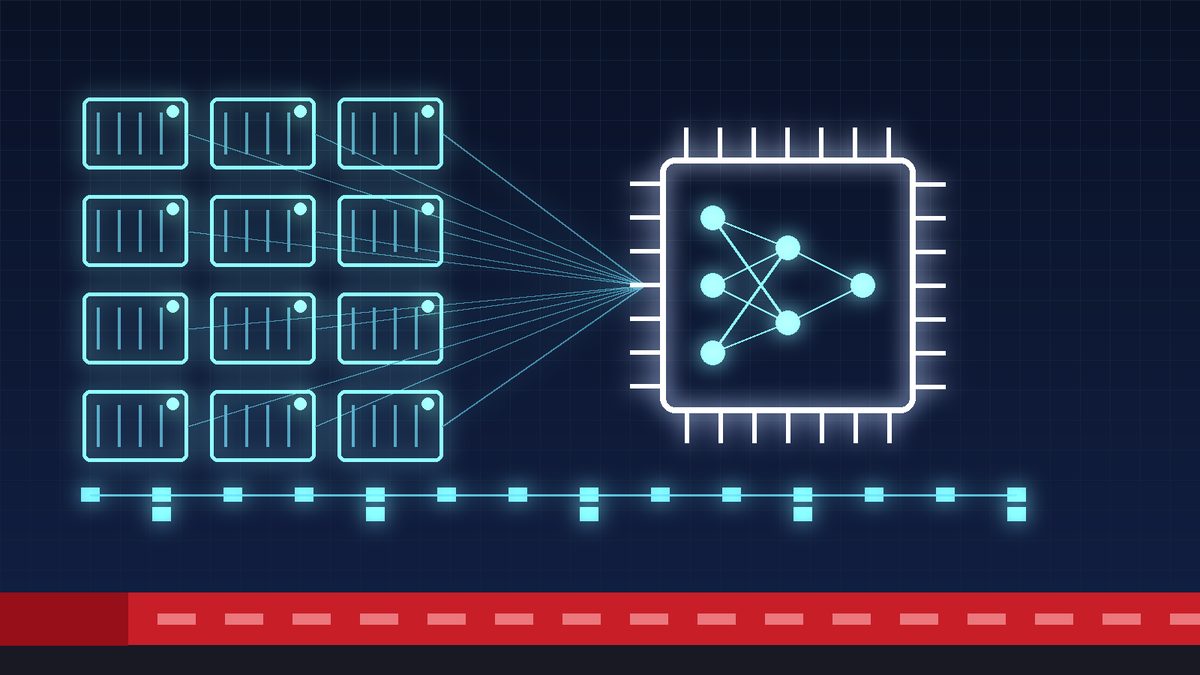
Hashference, an AI service built on Quai Network and promoted by its team, now accepts hashpower from Kaspa mining machines and pays for it in credit for AI models instead of coins. Quai announced the kHeavyHash route on Nov. 17 and promoted it again on Thursday, Nov. 19, at 2:28 p.m. ET, writing that “Kaspa ASICs are live now too.”
The service’s public route list on Friday morning showed the Kaspa route as live and accepting connections. That gives Kaspa miners a new kind of payout option at a time when the network’s hashrate is falling and a block reward cut is two weeks away.
How the Kaspa route works
Kaspa uses proof of work, the same basic security model as Bitcoin, but with its own hashing algorithm, kHeavyHash. The network is a BlockDAG: it keeps parallel blocks rather than discarding them and orders them with a rule called GHOSTDAG, producing about 10 blocks per second. Miners use ASICs, machines built only to run kHeavyHash.
Hashference sells access to AI models through one interface compatible with OpenAI’s and Anthropic’s APIs. Users can buy credit with crypto or earn it by pointing hardware at the service. Each accepted share adds credit “at the route’s published rate,” according to its documentation, with no payout threshold and no withdrawal fees.
The Kaspa route matters for one detail. In Hashference’s public routes data, the SHA-256, Scrypt and KawPoW routes are listed under the Quai network, meaning Bitcoin-style or Litecoin-style machines mine Quai. The kHeavyHash route is listed under the Kaspa network, with “Kaspa ASIC” as the hardware. That indicates Kaspa machines connected to Hashference keep mining Kaspa blocks, with the service turning the value of that work into AI credit.
Hashference’s documentation says the service credits shares immediately and “absorbs subsequent pool-settlement risk,” and that it stops accepting new work when an account or global limit is reached. Its marketing pages and mining docs still listed only the four older algorithms on Friday, so the Kaspa route had not yet been fully documented.
Quai’s launch post on Nov. 17 (@QuaiNetwork) made strong claims about value: “$50 of credit runs $5,000 of inference on select Dominant Inference models” and “$80 of credit gets you $100 of Claude at Anthropic’s API price.” KaspaNews has not tested those rates.
The mining backdrop
The timing reflects a hard market for Kaspa miners. Kaspa’s daily average hashrate was 305.5 PH/s on Nov. 20, down from 341.1 PH/s on Nov. 12 and 367.2 PH/s on Oct. 23, according to api.kaspa.org. A year earlier, on Nov. 16, 2025, it stood at 630.5 PH/s.
KAS traded at about $0.0259 on Friday morning, down 5.5% in 24 hours and about 33% over 30 days, according to CoinGecko. The block reward is 1.9445 KAS and falls to 1.8354 KAS at 00:31 UTC on Dec. 5 (7:31 p.m. ET on Dec. 4), a cut of about 5.6% under Kaspa’s monthly emission schedule.
By KaspaNews’ calculation, the network pays out about 1.68 million KAS a day in block rewards, worth roughly $43,600. Spread over current hashrate, that is about 5.5 KAS, or 14 cents, per terahash per day before electricity and pool fees. Those figures leave little margin for older machines.
Why it matters
For miners, the route adds an option for people who would otherwise sell KAS to pay for AI tools. Getting paid in credit avoids exchange and withdrawal fees, but it also means holding a balance with one company rather than coins in a wallet. The terms, the credit rate and the settlement process are set by Hashference and can change.
For KAS holders, the network-level effect looks neutral to small. If the route works as its data shows, hashpower pointed at Hashference still secures Kaspa. The difference is that the KAS earned is held by the service rather than by individual miners, and how Hashference handles that KAS, whether it holds or sells, has not been disclosed.
There is also a competitive angle. Quai markets itself against Kaspa: its comparison page says “Kaspa needs kHeavyHash machines,” while Quai “accepts SHA-256, Scrypt, and KawPoW hardware.” Courting Kaspa miners through an AI product gives Quai a direct line to Kaspa’s mining base, even though the Kaspa route itself does not mine Quai.
What to watch next
Watch whether Hashference publishes documentation for the kHeavyHash route, including which pool it uses and how it settles the KAS it earns. Miners should also check the credit rate against regular pool payouts in the service’s calculator before switching. Kaspa’s hashrate after the Dec. 5 reward cut will show how many machines stay online.
Sources
- https://x.com/QuaiNetwork/status/2122769074631696767
- https://x.com/QuaiNetwork/status/2123498544216580361
- https://hashference.com/v1/mining/routes
- https://hashference.com/docs/mining
- https://hashference.com/asic-mining-ai-credits
- https://www.qu.ai/compare/quai-vs-kaspa
- https://api.kaspa.org/info/hashrate/history?resolution=1d&limit=400
- https://api.kaspa.org/info/halving
- https://www.coingecko.com/en/coins/kaspa